

 I really enjoyed chatting with Dr. Katie Linder about Agile Faculty on the Oregon State University E-Campus podcast, Research in Action last month. It’s been great to see folks sharing their excitement about the strategies in the book and showing off their Scrum boards and the ways they’ve modified them – search the hashtag #AgileFaculty on Twitter to see for yourself.
So when Katie shared her new found love of Scrum boards on her personal podcast, You’ve Got This, I was doubly excited. Check it out here, and share your Scrum board stories on Twitter!

In a post from December, I covered Scrum board basics. The most basic version of a Scrum board is one that has three columns, one each for Backlog, Work in Progress (WIP), and Done. Let’s take it up a notch today with some tips for personalizing your board:
1. Call the backlog column whatever you want – Projects, Active Now, On Deck (like Dr. Katie Linder does), Priorities, etc. While “backlog” is the prescribed term for software Scrum, most Agile Faculty are not doing software Scrum. If backlog sounds to technical or mechanistic to you, choose your own term.
2. Add another column BEFORE the backlog – you might do this for one of two reasons (that I can think of): to move the project/story titles out of the backlog column in order to make more space OR to add additional sticky notes representing incoming projects or new ideas that you want to keep in mind for later.
3. Add another column between WIP and Done called Feedback or Waiting – many projects that we do get handed off for feedback and leave us in a holding pattern, whether that be feedback from an editor, colleague, grant funder, administrator, etc. This happens a lot in software, so they will often have a column labeled “in testing” or something similar. Keeping a sticky note that says something like “waiting for feedback from X as of <date>” in this additional column reminds you the project is active, if out of your hands, and dating it reminds you to check in if the feedback has been outstanding for too long.
4. Color code! So this is just aesthetic, but I like to go to the office supply store each semester and choose the color scheme for my next board. I buy multiple sizes to denote epics, stories, and tasks and use one color per project (up to six, then I usually have to repeat a color). Also helpful if a sticky falls off and you have to figure out where it came from.
5. Use a piece of art paper or a folder to make it physically portable – If you are peripatetic and not in one office regularly, you can still create a scrum board on the inside of a manila folder or on a large, foldable piece of art paper, Instant, cheap Scrum board. This is also a good way to have students make Scrum boards for course projects. If you do this, I highly recommend sticky notes that have full adhesive backs rather than just an adhesive strip so your tasks don’t fall off every time you fold or open.
What useful modifications have you made to your Scrum board?
 I’m excited to have had the opportunity to chat with Dr. Katie Linder on the Oregon State University E-Campus’s Research in Action podcast recently. Learn all about Agile Faculty as an approach to faculty work as Katie and I talk about the relationship between Agile and Scrum, how to use backlogs and sprints, and the joy of Scrum boards. There’s also a bonus clip about using a Scrum board as a teaching tool to improve group projects (and collect great data about student learning and metacognition).
Check out the episode here, and you can download it from iTunes and SoundCloud! Tons of other excellent episodes to check out as well; this podcast is a great resource.
Dr. Linder also has another wonderful podcast for academics called You’ve Got This, full of tips, tricks, motivation strategies, and real talk about faculty life. Short episodes are perfect for a quick commute or trip to the store.

 I’m calling this section of the blog “tea talk” because the posts in this category will be personal reflections, thoughts about teaching and learning and professional growth that I might share with a colleague over tea. Faculty narratives of lived experience are equally as important to our professional development as a formal evaluations or written research which is why I’ll share these reflections here.
Spring semester at my university beings tomorrow – we have a January Winter Term, so we always begin later than other institutions. Because I wasn’t teaching in January, but instead writing, I haven’t been in the classroom since mid-December. The break is nice, but it gives you time to build up the coming semester in your head, both positively and negatively. I am a worrier by nature, so you can imagine where my head goes.
This spring I will be solely teaching in the Design Thinking Studio in Social Innovation immersive semester pilot program. The Studio has Agile origins; three colleagues and I developed it after imagining what Agile higher ed might look like, doing away with arbitrary constraints like seat time, grades, siloed schedules of unrelated courses. You can learn more about the program through the link above, but let’s just say it’s a very intense teaching experience with huge potential for deep student learning if done well.
But because I am a worrier by nature, I worry. Often to the extreme.
What if the students hate the program and drop on the first day? What if they don’t like each other? Or us? What if no one wants to partner with us when it comes time for projects? etc. etc. It’s not really a healthy way to go into a semester.
One way I’ve found to break the cycle and regroup is to view my anxiety through the lens of the five Scrum values. While grounded in empirical control theory and based on the core tenet “inspect and adapt,” Scrum practitioners are also guided by five values that, when felt and lived, are supposed to strengthen Scrum teams, empower them for success, and lead to professional and personal development for each team member. Below is each value in bold, the value statement from the Scrum Alliance web page for each value in quotes, and my own interpretation.
Focus. “Because we focus on only a few things at a time, we work well together and produce excellent work. We deliver valuable items sooner.” The luxury of focus in often difficult during the semester. I teach undergraduates in mostly writing-intensive courses, so my students tend to be my focus throughout the semester. I often then prioritize service at the expense of research or writing up my own work. But because I am only teaching in my pilot program and it is a small number of students, I can focus during work days on the things I do value most – student learning, sharing teaching and learning research through SoTL publications, and sharing Agile Faculty with my peers. Yes, I have many service commitments, which I value, but I will work to focus this semester as best I can on teaching and writing to manifest my own priorities.
Courage. “Because we work as a team, we feel supported and have more resources at our disposal. This gives us the courage to undertake greater challenges.” I think it takes courage to walk into a classroom every day, perhaps less so into classes that are going well but definitely more so when they aren’t. Developing and teaching in my pilot program is in and of itself an act of courage. We are attempting to break down what we think is wrong about the artificial structures of higher education and create something really different. And that has been really hard in practice. We are doing something very new with our university, faculty, and students, so there is no clear road map to success; we learn from the pilots as iterations and hope for approval to run another iteration. It can be difficult not to take bumps in the road personally, but I will act with courage in facing both successes and roadblocks this semester to serve my students, colleagues, and my professional well-being.
Openness. “As we work together, we express how we’re doing, what’s in our way, and our concerns so they can be addressed.” It’s easy to keep what happens in your classroom private. And it’s just as easy to fall back on the “I’m really busy!” response when someone asks you how you are doing. Because my pilot program is a team-taught venture, I owe it to my colleagues to be open about my teaching strategies, strengths, fears, and problems related to the program so that we can design the best experience possible for our students and for ourselves. But when that trust is deep as it is with us – we’ve been working on this project together intensely for almost three years – it’s also easy to fall into venting or negativity because of the intensity of the program. So this semester, I will be open to my peers about my intellectual and emotional needs while providing the same support with encouragement and without judgment.
Commitment. “Because we have great control over our own destiny, we are more committed to success.” Focus and commitment are closely related for me, and even as I find myself panicking about making sure this semester’s second full iteration of the pilot program is wildly successful, I know it comes from a place of commitment to the ideas behind what we are doing, my desire to help students (and colleagues) succeed and excel, and my own desire for success and respect as well. Much of my anxiety comes from this place of commitment. Because we are a pilot that lasts a full semester, stopping to reflect and reboot if needed can be a challenge. This semester, when I begin to panic about something related to the program, I will stop, remind myself that it’s because I care so deeply about the program that I’m worried, and re-commit to the ideas and values of the learning experience.
Respect.”As we work together, sharing successes and failures, we come to respect each other and to help each other become worthy of respect.” Respect is the easiest value to live when I work with such wonderful colleagues. If we are being honest with ourselves through, in the heat of the semester sturm und drang, we can forget to respect our students and maybe ourselves. We can get caught up in group dynamics, live their stress as our own, and perhaps forget what we need as faculty to remain well, optimistic, and engaged in the learning environment. Going into this second pilot, I will keep an attitude of respect for my colleagues, students, and self, remembering that what we are setting out to do in this program is innovative, unique, intense, but important.
The values of focus, courage, openness, commitment, and respect already align with my values as a professional, and walking through them helps me to recommit and mentally prepare for the semester ahead. One of the things that really attracted me to Scrum beyond the project management framework was this attention to humanistic values and the mindset that we are all doing the best we can at a given moment and that helping those around us grow (and being open to that support ourselves) is equally important as productivity. I’m ready to begin the semester and open to what comes.
Do the Scrum values align with your own personal values? How might you apply them in your professional development or classroom?

Every Thursday, I’ll be briefly reviewing a book that I find to be interesting, engaging, and valuable for Agile Faculty. Because the Agile Faculty mindset values exploration, curiosity, and multidisciplinarity, these resources will come from a variety of different areas that speak to a wide range of interests, including higher education, faculty development, Agile and Scrum, design thinking and creativity studies, and social innovation. And I’ll throw in a little bonus review of a piece of fiction or non-fiction I’m reading just for fun.
 I was interested to read Dominica Degrandis‘ Making Work Visible: Exposing Time Theft to Optimize Work & Flow for a few reasons. First, who doesn’t want to better understand “time theft” and how to manage it? Even though this book is written for a software professional audience, the five area of time theft she articulates – too much work in progress, unknown dependencies, unplanned work, conflicting priorities, and neglected work – are relevant to all of us in our own contexts and especially in higher ed.
But I was most looking forward to better understanding kanban within an Agile context. Kanban and its connection to Lean and Agile have always been a bit confusing to me. The tenets of Lean come from the just-in-time manufacturing process perfected at Toyota as a way to maximize value and minimize waste in the production system. “Kanban” is Japanese for “signboard” and was/is used at Toyota as a way to visualize the system, identify problems, and determine how to maximize system throughput.
 But that’s all manufacturing. Software, and any knowledge work for that matter, does not work on Industrial Revolution or TPS paradigms. I’ve heard of kanban in Agile circles. It seems easy enough, basically a Lean version of Scrum without the sprints. Limiting work in progress is the constraint rather than time boxes. Visualization and limiting “waste” are two of the core tenets – a kanban board is like a Scrum board but with more “swim lanes” depending on how the team uses it (the image to the left is a sample board from software company LeanKit). Yet, I’ve been to major Agile professional conferences where vendors of Lean and kanban programs are basically yelling “Lean is NOT Agile! Kanban is not Agile!” to anyone who will listen (I had to wonder why they were at an international Agile conference if they were NOT Agile…).
Anyway, DeGrandis’ version of kanban lines up with my understanding of it as a sister to Agile and Lean. I appreciated how easy to read this book is and the fun doodles and drawings that illustrate the concepts and types of kanban boards. While it is an easy read, it is written for an audience who understands software development, so if terms like “technical debt,” “feature-driven development,” and “throughput” don’t really mean anything to you, you’ll want to skim through a good chunk of her examples.
But there is still a lot academics can learn from this text. I appreciated her discussion of how to identify the five time thieves. The way she talks about the time thieves is technical but easy to connect to faculty life – having too much work in progress and constantly reacting to unplanned work are certainly part of our everyday lives. She offers some ways to rethink how these time thieves impact our work. For example, she talks about the Backlog column on a Scrum/kanban board as really a list of options, things that could be done or might be valuable. She argues that once a ticket crosses the “line of commitment,” the line between Backlog and WIP, it becomes a commitment that must be kept. I like this idea of the backlog as a set of options. Dr. Katie Linder told me on Twitter that she used the term “on deck” instead of “backlog” when she set up her board because backlog felt so final and intimidating. I’ve always thought of the backlog as a set of possibilities, so both DeGrandis and Linder’s adaptations make good sense.
I also pulled two quotes that particularly resonated with me. First, “Busy people, however, do not signal productivity – delivered value does” (p. 39). She’s talking about this in the context of the fallacy that you can schedule people to “100% capacity” and expect 100% of work to be completed. Humans are not robots to be 100% utilized, so shifting the focus from time utilization to value delivery changes how we think about work. Faculty are always busy, but are we always producing value? Are there better ways to use our time and create value, whatever that means to us? Something to ponder.
I also liked the quote, “Beware the lack of good rules for prioritization – remember, when everything is priority 1, nothing is priority 1” (p. 101). As faculty, we often spend a lot of time reacting to unexpected requests and unplanned work as well as a lot of time waiting for something from others to whom our needs are not priority. Yes, we all need to have our own personal way to prioritize requests for our time effectively, but I also think this is a bigger conversation we need to have in higher ed. From a kanban perspective, there is a lot of waste in the systems of higher ed – I know that’s a major can of worms, but using a kanban mindset, looking for areas of waste that we can play with and adapt one at a time through little experiments could be a good way of approaching some of the change we know needs to happen but that seem to big to deal with.
So overall, I appreciated this book and think it’s worth a read if you are interested in other versions of Agile approaches to work management and comfortable with some technical language that might need to be interpreted (there is a glossary!).
Completely Unrelated Bonus Review
 I recently finished Jo Walton’s Thessaly trilogy – The Just City, The Philosopher Kings, and Necessity – and recommend the series highly. The initial premise is that Athena decides to set up Plato’s Republic. She takes people out of time who have prayed to her about Plato, sticks them on the island of Atlantis before the volcano goes off, gives them some robots to build things, and helps them bring thousands of ten year olds to start the city. Apollo is intrigued by the premise and incarnates so that he can better understand humans, excellence, and “equal significance.” The series is philosophically rich and engaging, the fantasy elements realistic, and the sci-fi parts a unique twist (it was published by Tor, after all).

 My first #AFSprint challenge is complete, Spring semester is right around the corner (looking at my original post, it looks like I didn’t set an official end date, so we’ll say today, January 23rd to make it an official three-week challenge). This week was a push and a pull – I feel like I was both pushing through the articles and pulling teeth at the same time. But by the end of last week, goal setting article is completely restructured and about 75% done. And even better, the team teaching article is fully drafted and ready to go to my writing group for discussion Here’s what my board looked like to start last week:
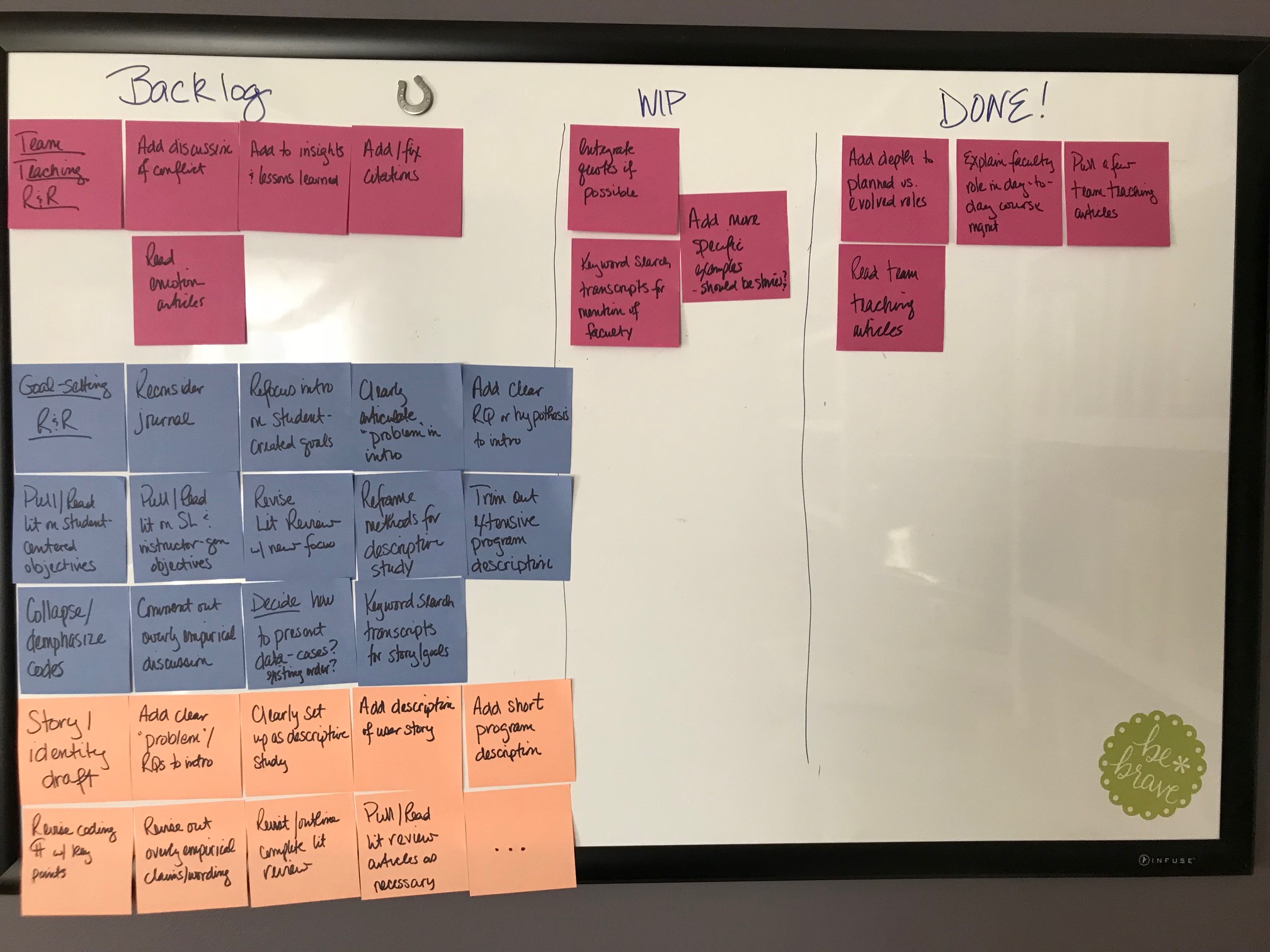
 And here’s what the board looked like by the end of the week (yes, a little fun with photo filters here):

Move those last three pink stickies into Done, and you have my end-of-sprint board update. A lot of progress here when you compare the Backlog and Done columns across the week! And that’s with me revising the Backlog tickets for the team teaching article twice and the goal setting article once during the week.
Now, a pure Agilist would not be impressed with this. I started with two articles three weeks ago and barely finished one of them. One of the major tenets of Scrum is to finish workable or valuable product by the end of the sprint. In a mechanical sense, I should have stuck to one article, completed it entirely, and then jumped to the other. But, you know what? I’m not mechanical, I needed to change gears and follow the energy to be productive while maintaining my interest and spirit while keeping up with non-writing related work (and a few migraine days). No one is really waiting on pins and needles for me to finish these articles. I’m writing for me (and my colleagues in the program I’m writing about). So I’m comfortable with my decisions throughout the sprint challenge.
Writing is personal.
As I acknowledged mid-week, one of the of the reasons for the push-pull dynamic this month has been an underlying emotional current for me. I’m writing about a pilot program that my colleagues and I put our hearts and souls (and careers) into. And it was a struggle, hard intellectual and emotional work, intense, full of really high highs and lowest lows. I know that sounds dramatic, bear with me, but I am still processing that semester, even as we plan the day-to-day details of the second pilot which starts very soon. Through writing these articles, I’m processing that experience for myself and so that we can improve the second iteration (like any good Agile project) and share knowledge with our peers in higher ed who we know will find value in the work.
So completing these revisions, which required diving deeply back into the pilot semester, has been in many ways a new writing context for me. I frequently do Scholarship of Teaching and Learning, writing about my own classes and student experiences using Scrum. But the pilot program was so much more of a risk, a challenge, so I feel differently about the scholarship piece. It’s OK – we need to not deny the emotional aspects of teaching and learning if we want to remain engaged, active, vital faculty. But I’m not sure I would have been brave enough to work through these articles without the #AFSprint challenge accountability – if you’ve been following along, thank you.
I learned a lot during this sprint (hope you did too!) and look forward to sprinting with you again soon!

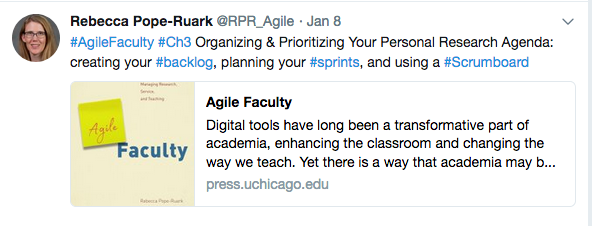
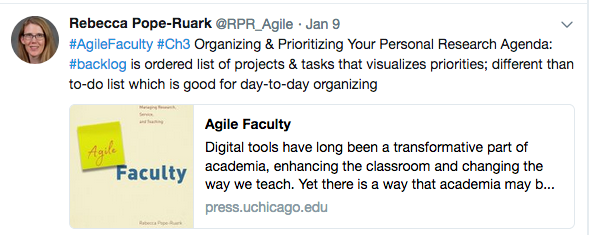
On Twitter, the week of January 8th was all about Chapter 3 of Agile Faculty – Organizing and Prioritizing Your Personal Research Agenda. Here’s the tips in a nice, easy to skim format:


 The week of January 15th is all about using Scrum to (re)redesign courses. Follow along on Twitter.
Week 2 of the first #AFSprint writing challenge is in the books, and I’d say the theme of the week was “follow the energy.” At the end of the first week of #AFSprint, I realized that I didn’t have good energy around the team teaching piece I was working on, so I decided to switch gears to one of the other articles on my sprint backlog, the goal setting article. I knew it was a much bigger revision, but it seemed more interesting to me at the time. I made the pivot on Friday and checked off some of the easy tasks. My Scrum board looked like this when I started Week 2:
 I definitely found some momentum on this article. The first few days of the week, I needed to do some additional research and reading for the lit review because I was completely reframing the argument. I did the important but unglamorous work – and realized this was more than a revision, it was a complete and total overhaul.
By the start of day 6, I was ready to write; the board looked like this: 
If you you compare this board to the first board, you will see two things. 1) I changed the tickets in the backlog for the article because I had decided to reshape the data section into short case studies. 2) “Collapse/deemphasize codes has been in WIP for several days – I was procrastinating on that one, just like I was procrastinating on “pull student quotes from interviews” last week. So 1) is good – be flexible as you go, that’s what sticky notes are for! And 2) is not good. If you don’t want to do it or are avoiding it, take it out of WIP until you can’t possibly ignore it any longer, OR rethink why you “have to” do it in the first place. It could just be that the ticket is too large and you need to break it up into smaller tasks.
By the end of the week, I had about 3500 words of the goal setting article, which is really about student learning outcomes and objectives now, complete and solid. And I’d moved a whole bunch of tickets into the done column during the week:
 That annoying “collapse/deemphasize codes” ticket is still in WIP, really because I actually have to do it now that I’m ready to write the data section You’ll also notice two more things on this version of the board. 1) I changed my mind on the case studies in the data section and decided to go with chronological stages instead, more the way the original article was organized. This will be an easier edit and makes more sense given the way the lit review shaped up.
And 2) there is a new set of sticky notes on the board. As I was reading for the team teaching article last week, I went on a little tangent in my reading that I thought was relevant at the time – student emotion in service-learning. That reading didn’t end up being applicable to the team teaching piece, but I found it really fascinating and illuminating in respect to another article I want to write that is further down the backlog. I am NOT starting a new article mid-sprint; being flexible should only go so far. If you keep changing the backlog during a sprint, you’ll never complete anything. So I just put up a few notes of really minor things I can do if I need to change mental gears for a few minutes without totally getting out of the flow of writing. I also added one ticket to the team teaching WIP as well and for the same reason – something I just need to think about for a few minutes that won’t interrupt my larger focus.
So that’s Week 2 of my first #AFSprint writing challenge. You can follow along during the week on Twitter using the hashtag #AFSprint. Follow me for other tips on applying Scrum and Agile to your faculty work, and take a deep dive by ordering my book, Agile Faculty: Practical Strategies for Managing Research, Service, and Teaching, available now from the University of Chicago Press – use the code PRAGILE for a 20% discount on the cover price!
 I read all the time. I always have. I almost always have a book with me in case of found time, and my monthly book buy puts a dent in my fun money every month (totally worth it). Like any big reader, my shopping cart is bigger than my available time, so I find myself with many fascinating books on my shelves (which I had built-in to my home office four year ago and which regularly overflow and demand rearranging).
So in 2018, I’m going to shop my shelves as much as possible before I click “purchase” and add to Amazon profits. I scoured my shelves and made a list of the found books I can read this year before buying new ones*. Here’s my list (yes, I like to play with colored Sharpies):
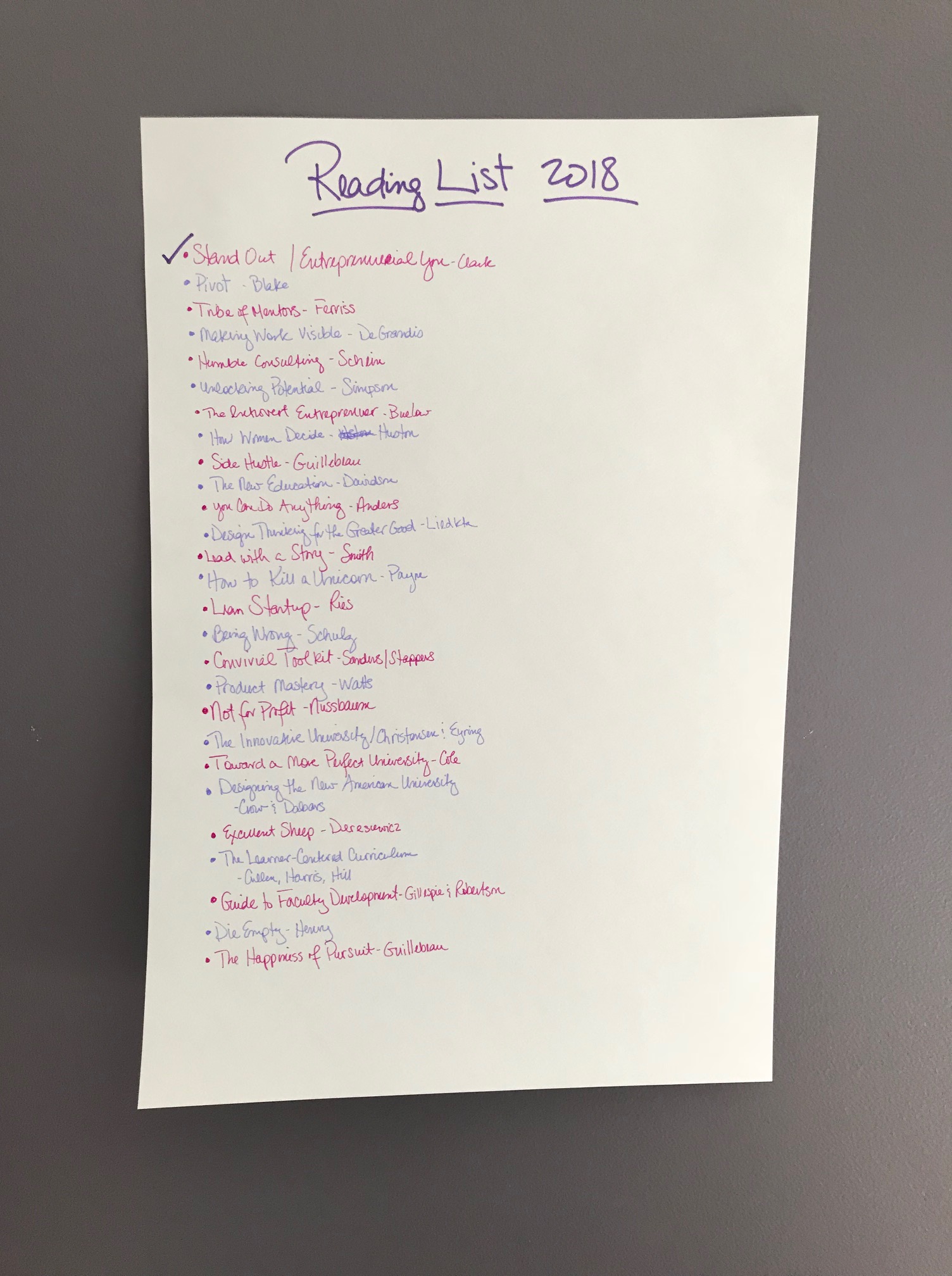 My shelves are definitely bountiful with lots of great reads in areas I care about like design and creativity, professional development, higher education, intra- and solo-preneurship. I confess the last two are in still in my shopping cart, but they sound awesome. Right now, I’m reading Jenny Blake’s Pivot and Dominica Degrandis’ Making Work Visible, while working through the short advice essays in Tim Ferriss’ Tribe of Mentors. Look for Agile Faculty Book Club reviews soon!
*I will be getting nine new professional development books this year as part of Adam Grant, Susan Cain, Dan Pink, and Malcolm Gladwell’s 2018 The Next Big Idea book club. I’m looking forward to reading the books they select, meeting quarterly with my reading group to discuss, and interacting with these thought leaders and other readers in the club online community. Care to join me?
For the month of January, I’m running the very first Agile Faculty writing sprint challenge on Twitter, using Scrum strategies to meet my writing goals for the month. I’m tweeting every day about my progress, process, wins, and challenges. Look for the #AFSprint hashtag!
The first week of the #AFSprint writing challenges was a short, three-day push to get my plan set up and start making concrete progress toward my writing goals for the month. As I said previously, I’m not teaching in January (spring semester starts on January 29th) and have three articles related to the Design Thinking Studio in Social Innovation pilot program that I really need to get off my plate. Here’s my initial Scrum board:
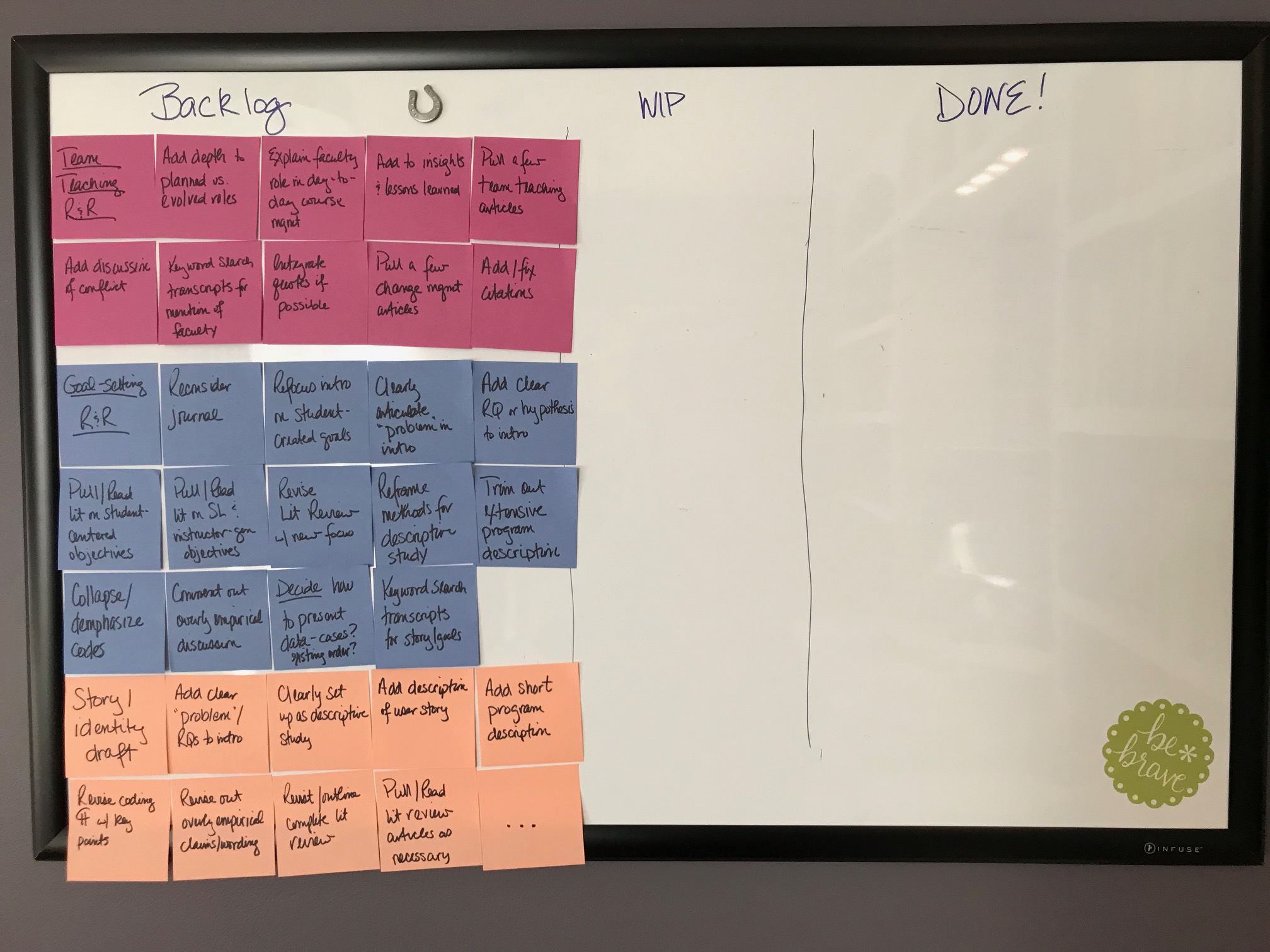
I color-coded each of the three articles and prioritized them in order of level of effort each would take, least to most. The first article, a team teaching essay, seemed to have the fewest revisions needed and was the shortest of the three projects in terms of word count.
Notice I didn’t prioritize by time but instead by effort. We often estimate time in ideal hours (“oh, this revision will take about four hours…”), we don’t live in an ideal world. Those four hours might be spread out over days as we deal with other aspects of life and work. Estimating on effort or complexity helps us avoid that challenge. So to start me off and help me ramp up my productivity, I chose five tasks, or tickets, for my first work day:
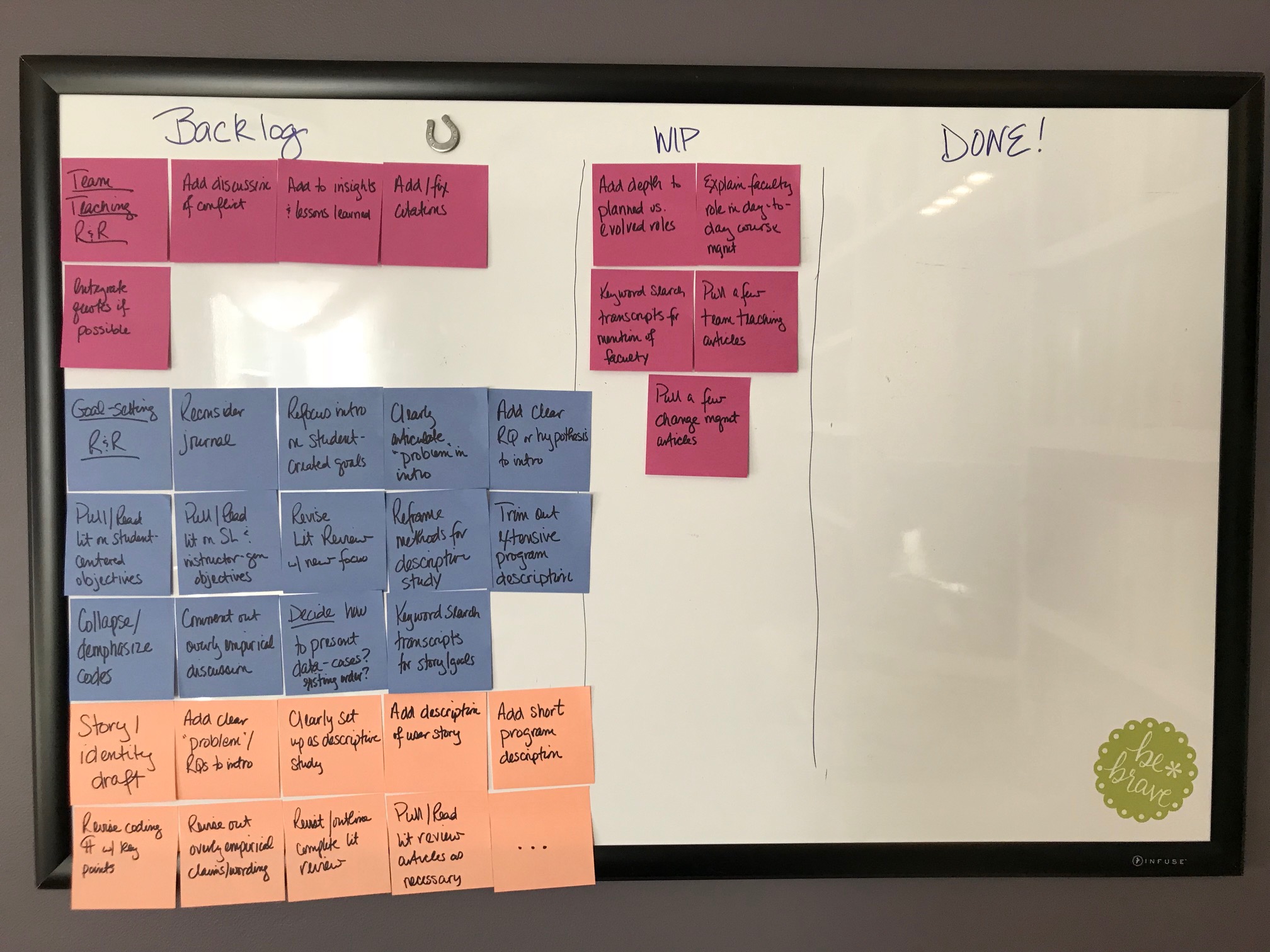 Because the team teaching article is more essay than research piece, it seemed easy to add some of the additional examples and explanation the editor requested and to pull and read a few more articles about team teaching. I met my goals for this day, even though I ended up reading team teaching articles instead of keyword searching student interview transcripts (see below). I felt like I was making progress but also like it was pulling teeth to stay focused.
 As I was working on my tickets for Friday, I finally admitted to myself that this essay was turning into much more of an essay-research article hybrid that was going to be more effort than I expected. Plus, I wasn’t sure how my co-teachers would feel about the change in emphasis and had some questions about how to frame the example stories.
After taking a break for a few hours, I decided to pull a few tickets from the second article on user stories and goal setting – easy things that seemed more like editing than writing – so I could get some small wins for the day. Surprisingly, I found working on this article to be much more interesting and engaging, and I completed several tickets on a Friday afternoon, which is historically not my most productive time.
 So, going into the first full week of my #AFSprint January writing challenge, I’ve scaled back on the team teaching article and decided to follow my energy on the user story article. I’ll do as much as I can, knowing I’ll need to split focus soon because the introductory framing and lit review need to be completely redone. But I’m interested in how it will take shape, so I should make good progress in the first part of the week.
Inspired by seeing my progress visually? Follow along with the #AFSprint hashtag or join me in the challenge. Tweet your updates and Scrum board images to the #AFSprint hashtag, and tag me too! Happy writing!

 rebecca pope-ruark