

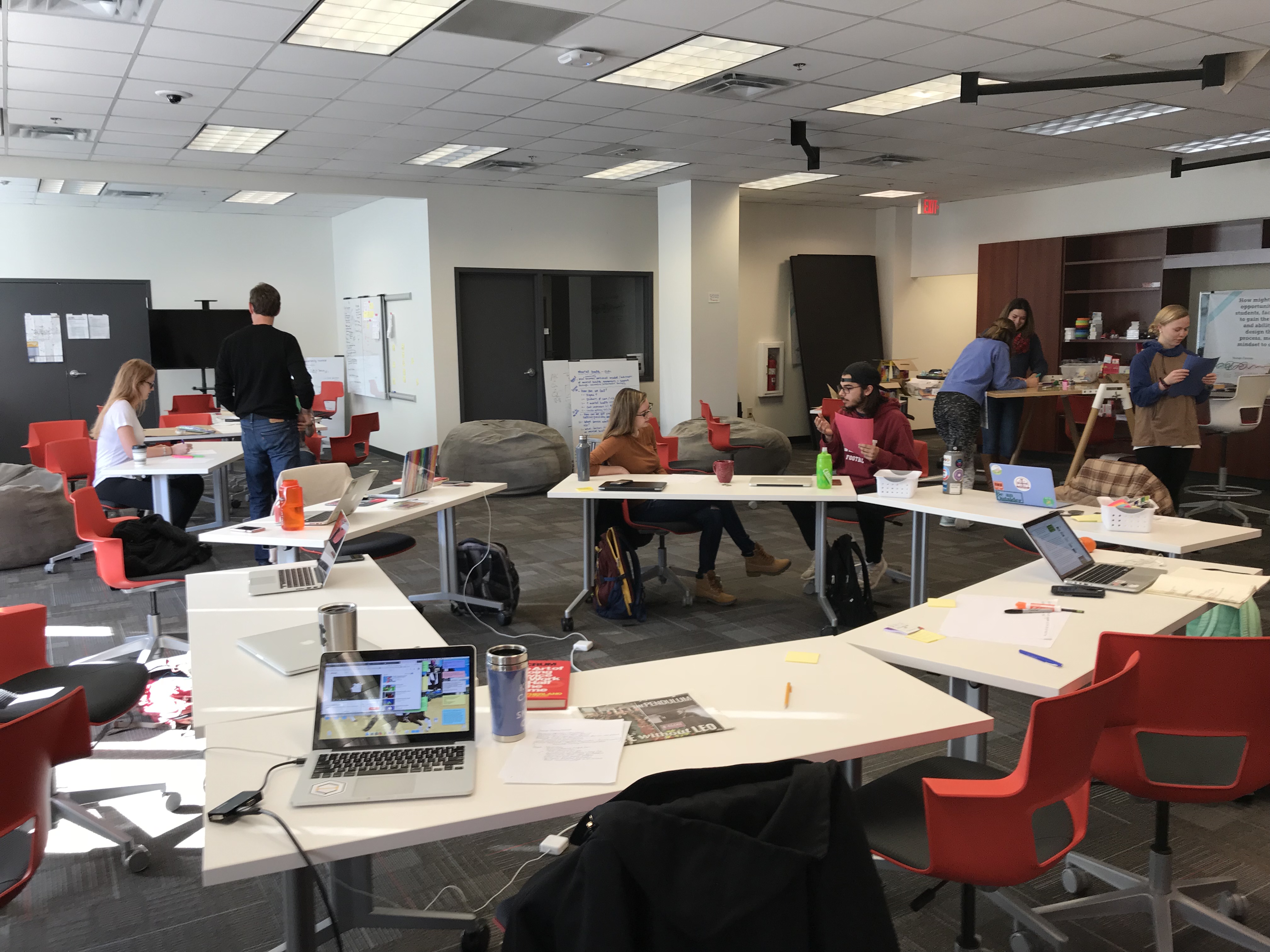
 The Design Thinking Studio in Social Innovation is a major pilot program I helped create at my institution that I’d like to share a bit about here now that it’s midterm. In a previous post, I talked about the connections I see between Agile and design thinking approaches, and this program is the result of that marriage in many ways. A group of colleagues and I got together three years ago to talk about how we can implement Scrum as a pedagogy in higher ed, realized that all the inherent legacy features of higher ed (like seat time, grades, taking multiple unrelated courses in rigid semester structures), and began to imagine what education could look like without those limitations.
The result was the Studio program, which we somehow managed to imagine, proposed, and stand up for the first pilot in Spring 2017 in about 18 months – lightning fast for higher ed, even at a progressive and innovative university like Elon. In a nutshell, students who sign up for the Studio are blocked registered into a 16 semester hour program, a full semester course load, and sent that semester learning design thinking strategies, social innovation and asset-based development practices, and Scrum to ultimately work with our community partners to define, develop, and test possible interventions or approaches to community wellness challenges. The program is team taught by myself and colleagues from communications, interactive media, and computing sciences.
 Students in the first pilot developed their branding and mission, landing on The B•HIVE, and acronym for “be human-centered, be innovative, be visionary, and be empathetic.” Students in this semester’s second pilot are currently revising the website to their tastes and are actively blogging on The Buzz about their adventures in the classroom and community. You can also follow them on Instragram @elondesignthinking.
Over the next few weeks, instead of Book Club posts on Thursdays, I’ll be sharing more about my teaching adventures in the Studio including how we are designing a design thinking pedagogy, what it means to team teach in this environment, the pros and cons of meeting five days a week, and the activities and projects students are sharing. The Studio is what higher ed could be if we removed so many of the structures that hamstring us – but it’s also intense and messy and as emotional as it is intellectual, which is what higher ed should be.
 In early March, my colleagues Phillip Motley, William Moner and I presented about the Design Thinking Studio in Social Innovation to a packed room at the annual SXSW Edu conference in Austin, TX. Edu is the precursor event to the larger SXSW festivals and brings teachers, innovators, and stakeholders together for three days of deep diving into what education at all levels can look like and achieve. AND Agile Faculty is in the SXSW bookstore through the entire festival! Here’s a summary of some of the tweets from our event.


 Have you heard about the attention design thinking is getting in higher ed recently? Peter Miller’s 2015 Chronicle Review article “Is Design Thinking the Future of the Liberal Arts?” might have piqued your interest (or flown under your radar), but I think it’s a question worth considering.
Design thinking is a recursive, iterative way of thinking about complex problems distilled from the work of engineers, architects, and graphic and industrial designers. Typically the design thinking process includes phases for understanding a problem, empathizing with those affected, (re)defining the problem, ideating possible interventions or solutions, rapidly prototyping the best ideas, and testing prototypes with members of the intended audience. Design consultancy IDEO and the d.school at Stanford are the most recognized proponents and users of design thinking, though their process starts at empathy rather than understand.
From my perspective as a rhetorician, the design thinking process, which is really just a series of stages and mindsets for creating something for others, aligns nicely with the rhetorical process of purposefully designing a communication approach by carefully assessing the needs of a given audience, including your relationship to them as a speaker or writer, in a given contextual situation in order to craft an appropriate message to meet their needs. I also do a good bit of service learning in my upper level professional writing courses, so the design thinking process makes sense to me in helping students focus on defining problems when they are really obsessed with solving them.
My university is moving forward with a design thinking initiative that is being received by my colleagues in the arts and humanities with skepticism. There are political dimensions to this reception that I won’t go into here, but this skepticism isn’t isolated to my institution. Design thinking practices have a reputation as being solely tied to business and entrepreneurship, for better or worse, which sets off warning bells for anyone in disciplines being cannibalized by professional schools already. Ironically, if you read into the scholarly literature on design, “true” designers hate “design thinking” and see it as a business school bastardization of their sacred process, which they call “designerly thinking.”
Design thinking is just another tool for critical and creative thinking.
But in my view, design thinking is just another process tool, like critical thinking and other creative thinking processes, and one that is inherently humanistic – the entire process is grounded in understanding the human condition in specific contexts and working for and with people affected by complex, messy problems improve their situations. Those of us in the arts and humanities are already using and teaching strategies and ways of being that align with design thinking, and I personally see nothing wrong with occasionally couching what we do in terms of design thinking, which might resonate more with students and their future employers. But I also recognize where my colleagues are coming from and see the challenges associated with connecting to a “fad” way of thinking in disciplines that are in many ways timeless.
Peter Miller ask the question, is design thinking the future of the liberal arts? His answer is not yet and his argument is compelling and worth a read. IDEO also has a free toolkit for educators you might look at for some more information.

One of the things I like about Scrum so much is the intentional shifting of language. Projects can be epics, and activities can be stories. We can sprint instead of just working. We groom the backlog rather than just culling the to-do list. We reflect on commitment not just progress. I know the language turns many people off – why create new terms for the most basic pieces of project management?
The last thing we need is more jargon, right? Except when that new language helps us to break common habits and consciously think about what we are doing in new ways.
Software developers create user stories in order to keep themselves focused on the user’s needs and motivations while they work. A basic version of the user story format is
As a <type of person>, I want <to do/be/have something> so that I <can meet some goal>.
Throughout Agile Faculty, I talk about articulating your projects as epics with component stories and tasks. In chapter 6, I talk about using epics and stories to create personal goals in the mentoring process, and in chapter 7, I show readers how to (re)design a course using epics and stories directly connected to student learning goals. I’ve also been writing about the connection between user stories and student learning outcomes as well as identity. So I’ve been giving a lot of thought to the different uses for user stories, especially as goals setting tools.
In this post though, I want to talk about writing a good story. A good story hones in on identity, desire, and motivation. It is broad enough to have multiple possible ways of being resolved but narrow enough to ultimately be actionable in a realistic amount of time. Good stories also have measurable criteria for success, ways you will know you have completed the story effectively. These stories, then, are too broad:
- As a writer, I want to write a good academic book on Scrum so that I can become a thought leader.
- As a professor who cares about her students, I want to teach design thinking so that they can be better creative professionals.
- As an academic entrepreneur, I want to create space for academics to find their vitality so that they can thrive.
These seem like good goals, but in reality, how would you actually accomplish these? Or ever really know if you’ve accomplished them? Could you pinpoint when you’ve become a “thought leader”? What does that even mean to you? Can you ever know if you students are “better” creative professionals in the future? You can see where I’m going here. These might be long-term goals, but in the shorter term, goals like this ultimately become too aspirational (and vague) to be actionable or measurable.
In my new year post about using stories to plan your year, I shared three big stories I had written for myself. Here’s one of those:
- As a leader and faculty member in our Professional Writing and Rhetoric (PWR) program, I want to create a solid foundation for the new major in terms of marketing, recruiting, and prioritizing PWR so that I/we can realize our dream of a strong and vital PWR presence on campus and in students’ education.
This is an epic, part of my five-year plan; there are multiple stories within it that I can break out and down into more specific stories and actions I can take over time to reach the broader goal of a thriving new major. For example, I can create stories like these:
- As a PWR leader and former marketing writer, I want to design marketing materials for students, parents, Admissions officers, and colleagues that distinguish our program as the liberal arts alternative to Communications and attract inquiries from at least 40 students in the first year.
I could further break this down by audience and then create tasks related to market research, strategy, messaging, products. I can judge success based on how many students reach out to PWR faculty for information or declare the major and if/when they encountered the marketing materials.
- As a PWR faculty member with teaching and service responsibilities outside of the program, I want to devote six hours per week on reading disciplinary literature, working on my Cs grant project, and contributing to joint PWR writing projects so that I can recommit to the program and its success.
I could then break this epic down further down by reading, working, and contributing to develop actionable steps for each. Each could be assessed by number of productive hours spent, developing an ongoing lit review of new research I read, successfully publishing on my grant project, and successfully publish co-authored articles and textbook resources with my PWR colleague.
While often hard to zoom in on the level of clarity necessary for a good story – it’s so easy to add compound elements that can overcomplicate the story (I struggle with this myself as you can see) – even just acknowledging the goal might not be actionable or achievable and working to break that down further is a good starting point for writing useful goals in the user story format.
How do you set useful goals? Does the story format seem like something that might work for you as a new way of articulating meaningful goals?

At the start of the year, I made a commitment to “shop my bookshelves” and to try to read 25 books that were already on my office shelves (plus two more I was really curious about). The idea was that I wouldn’t buy new books until I’d gotten through a bunch of these. HA! I can’t stop buying books, and I’ve gotten at least three Amazon shipments since I wrote that post, but I’m still committed to reading these books too. So here’s how it’s going:

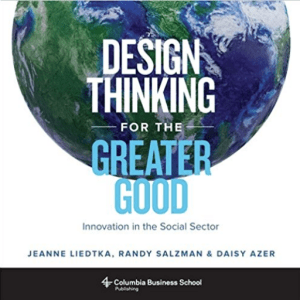
I’ve completed several books so far, including Pivot, Making Work Visible, How Women Decide, Unlocking Potential, and Design Thinking for the Greater Good. Pivot, Unlocking Potential, and How Women Decide were good reads for personal development, thinking about how I interact with others, who I want to be, and what I want to do in different ways. Making Work Visible, which I reviewed here, is about Kanban, a project management framework that comes out of Lean manufacturing but can also be considered Agile (depending on who you talk to). We used Design Thinking for the Greater Good in my Design Thinking Studio in Social Innovation program a week or so ago to help our students look at ways design and innovation can be done that aren’t necessarily attached to entrepreneurship or business.
I’ve also dipped into several of the other books on the list but haven’t finished them, especially Side Hustle and The New Education. I’ll dig back into those over Spring Break (which starts in two weeks as I type this). I realized that Tim Ferriss’s Tribe of Mentors book isn’t something you read all the way through, so I pop in a read a couple of advice sections every once in a while to get some inspiration.
A few things have come off the list as well. I don’t think I’m going to go for my Scrum Product Owner certificate right now, so I removed one of those books as well as Humble Consulting and the Guide to Faculty Development. I’ll come back to those eventually, but for now, I’m putting them back on the shelf.
 After I had written the original challenge post, I decided to join a book club put together by Dan Pink, Adam Grant, Malcolm Gladwell, and Susan Cain called The Next Big Idea Book Club through Heleo. I got my first books last week with Pink’s new book When, Daniel Coyle’s The Culture Code (which was definitely on my wishlist already since it’s about groups and collaboration), and a book on endurance by Alex Hutchinson (I wouldn’t have bought that one for myself, so it will be interesting to see if I like it). Pink’s To Sell Is Human made me really mad (like he invented the idea of persuasive writing and speech…hello? rhetoric?? 2000+ year old art and practice?), but I’ve liked his other work and have already confirmed a few things about when I work best based on the research he’s pulled. I was excited about Coyle, but the intro was all about the marshmallow challenge, which is pretty cliche. And I HATE the marshmallow challenge. But I’m hoping I can get past that and learn some new stuff about teams that aligns with my interests in Agile and Scrum.
So that’s where I am with the reading challenge. I’ll check back in in a couple of month to report on additional progress! What are you reading?
 When you sit down to plan your sprint backlog or weekly to-do list, how do you estimate what you’ll need to invest to check it off the the list? The most common way would be to think about each item on in terms of how much time it would take to accomplish. Pretty easy to estimate how long it will take to send that important email, give a final polish to an article you are submitting, or plan a lesson for a course you’ve taught before. These are known activities that we have temporal references for.
But many things we do as faculty are much harder to estimate in terms of time. It doesn’t help that humans are notoriously bad at estimating how long things will take to do. This may be because we tend to think about our activities optimistically by ideal hours rather than actual hours. Yes, there is a difference.
When we think in terms of ideal hours, we estimate how long we think something will take us to do. But this is usually an optimistic guess. Maybe you think it will take you about three hours to do a last revision and polish on the article you want to submit the week before classes start. What are the odds of finding three uninterrupted hours to do that work? Especially right before the start of a semester, when syllabi need to be completed, lesson planned, meetings come out of nowhere, and students start knocking.
So, what you think will take three hours may, in actual hours, take three days of finding snatches of time here and there to cobble your three ideal hours together.
How can we more effectively estimate our tasks and activities? If you have been keeping track of your time and fastidiously set aside time for projects, you may have a good sense of what your velocity is, so estimating by time might work for you. If not, consider estimating by effort or complexity instead.
 One way to do this is using t-shirt sizing. Rather than thinking about how long something takes, compare your tasks to each other in terms of effort by assigning each chunk of work a t-shirt size – a lit review might be an XL, while a final edit might be a S or even XS. We know that an XL shirt is 3-4x bigger than a S, but relatively bigger not exponentially bigger. This gives you a sense of your tasks relative to each other, so you can choose the tasks you can realistically work on in the actual time you have available.
Do you fall into the trap of thinking in ideal rather than actual hours? How do you estimate your tasks and projects? How might thinking in terms of actual rather than ideal hours impact your planning and work?
It’s Thursday! Time for another edition of the Agile Faculty Book Club. In February, we are focusing on my favorite books related to design thinking and innovation because I’m back to teaching in our Design Thinking Studio in Social Innovation immersive semester pilot program and that’s what I’m thinking about.
 Today’s post is about Steven Johnson’s Where Good Ideas Come From: The Natural History of Innovation. If you aren’t familiar with Johnson’s work, drop everything, go to your local bookstore, and buy it all. It’s brilliant, engaging, full of metaphors that illuminate complex concepts, etc. My second favorite of his is How We Got to Now: Six Innovations that Made the Modern World – instead of going for the obvious (the printing press or movable type, the steam engine, the computer), he spotlights glass, cold, sound, clean, time, and light. Truly, I wish my brain worked like his, but since it doesn’t, I’m grateful to read and reread his books and explore the web of ideas he creates. Or maybe “unveils” is a better term.
ANYWAY. Back to Good Ideas (see, I get really carried away talking about Johnson’s work!). Good Ideas is the first full book we require students in the Studio to read because it breaks down so many of the pervasive cultural myths about innovation, creativity, failure, and heroic genius. Core to Johnson’s argument is the understanding that, contrary to the Great Man myths of history, good ideas do not come from a lone genius toiling in solitude in a lab or garage. The best ideas are syntheses of smaller ideas floating in the atmosphere, shared among people in cities and shared spaces. Good ideas are made of available parts and a spark that combines them at the right time.
Good ideas are born in the the adjacent possible, a concept which students always grab tightly. He explains that ideas often come in an order; one ideas understood opens doors to other ideas not possible before. One idea opens up new thresholds to explore in the adjacent possible. Rarely do great ideas manifest by leaping far ahead of the adjacent possible, and when they do, they are frequently ahead of their time (Babbage’s Analytical Engine being a prime example).
Good ideas are not often flashes of genius but instead “slow hunches” that develop over time through reading, conversations, prototyping, testing, failing, and trying again. We forget that Darwin took decades to actually get to the complete argument made in Origin of the Species. We forget that Edison worked a huge number of projects, failing every day to come up with anything that works, and even when he did not seeing it for the purposes it would ultimately be used for. We also forget that what made Silicon Valley in the 70s and 80s such a hub of innovation was less the upstarts in their mom’s garages and more about the happy hour conversations in the few bars in the valley at the time. Good ideas don’t thrive in isolation.
I love this book, for myself and for students, because it shows us that innovation isn’t an act of genius, but an act of paying attention, of trying new and maybe silly things, of taking time to explore and read and discuss, of failing but seeing that act as a way to generate data. It grants us all permission to be innovative; we don’t need a pedigree or a garage; we just need curiosity, time, and engagement in the world around us. That’s powerful. Students almost always report feeling better about themselves, their creativity, and the way of seeing the world after reading this book. So while Johnson doesn’t necessarily talk about design thinking per se, the book represents the whole ethos of design thinking as a human-centered process based in empathy and curiosity, in problem framing not just problem solving, in divergent thinking not just convergent thinking. Definitely worth your time; I dare you to put it down once you start it.
Completely Unrelated Bonus Review
 Continuing with my sci fi theme, I recommend Daniel H. Wilson’s Robopocalypse series. It’s only two books right now, Robopocalypse and Robogenesis, but there were three years between the first two books, so hopefully a third one is coming this year. These books aren’t my style, and I’m not sure why I even picked it up honestly. These are really war novels full of battle strategy and the costs of war interwoven with deep thinking about the potential dangers of sentient AI and human dependence on computer technology. But I enjoyed the depth of humanity revealed in so many different ways and characters and the opportunity to think about the social and human consequences of our creations.

The sprint is the basic unit of productive time in Scrum. According to the official Scrum Guide (2017 version), the sprint is “the heart” of Scrum, a period of less than one month during which teams commit to and complete usable pieces of functionality. The sprint is the container for everything else – planning, working, reviewing product and process.
Sprints are valuable constraints in any type of knowledge work. Scrum was created to help software teams accomplish more work on a regular basis rather than dawdling until right before the release date. The sprint is frame within that work is done.
Should Agile Faculty sprint? Totally up to you.
I honestly go back and forth on it. When I do sprint, it’s usually in 2-3 week timeboxes, such as the three-week window I used this January for my writing challenge. Pre-sprint, I chose a couple of things to focus on completely during that time, set up my Scrum board with only those projects, and tried to focus on the work I had committed to (results were mix as you’ll see in the post).
When I’m not sprinting, I’m still being Agile and using my Scrum board; my goals are still prioritized and I use them to guide my work, but I don’t timebox it. I just plan, execute, and reflect regularly instead of in a two-week period. This is closer to Kanban, which you can learn more about here and in this Book Club post I wrote about Dominica DeGrandis’s recent book, Making Work Visible.
Personally, I find that I don’t need to sprint to be productive in meeting my goals, but it helps if I’m working with a group because we can time our work and meetings according to a sprint cycle. Sprinting also becomes useful when I find I’m not making progress without the accountability. So I might bring a colleague in, talk about what I’m going to accomplish in two weeks, and then schedule a meeting with that peer to meet for extra accountability.
Do you sprint or go with the Kanban flow? What works best for you, and why?
Every Thursday, I’ll be briefly reviewing a book that I find to be interesting, engaging, and valuable for Agile Faculty. Because the Agile Faculty mindset values exploration, curiosity, and multidisciplinarity, these resources will come from a variety of different areas that speak to a wide range of interests, including higher education, faculty development, Agile and Scrum, design thinking and creativity studies, and social innovation. And I’ll throw in a little bonus review of a piece of fiction or non-fiction I’m reading just for fun.
For February, Book Club will focus on design thinking resources, texts that have inspired me to think about innovation, process, empathy, and curiosity in new ways. Why design thinking? About three years ago, some colleagues and I who were interested in finding better ways to use Scrum in the higher ed classroom got together, and in a spit-balling brainstorming session, we wondered what truly Agile higher education would look like – iterations instead of semesters, projects instead of courses, action instead of seat time, feedback loops instead of grades. Fast forward and we are currently running the second pilot semester of the Design Thinking Studio in Social Innovation program that was born of those discussions.
I see a lot of similarities between design thinking and Scrum which I’ll cover in a blog post next week. Here I’d just like to share some books you can explore if you are interested in learning more about design thinking and the mindsets that ground this type of thinking.
Design thinking is essentially a distillation of the development process designers, such as graphic and industrial designers and architects, employ when thinking through projects. If you’ve heard of design thinking ambiently, odds are you found or heard about the work of the Stanford d.school, IDEO, Tim Brown, and David and Tom Kelley. Some of their books are listed below, but this is just one version of the process – although I have studied the d.school/IDEO work, it is one flavor of the Kool-Aid and is often framed in great stories (but little empirical evidence to support the sweeping claims. If fact, much of the design literature shows designers preferring the language of “designerly thinking” and see the Stanford/IDEO version a bastardization of their sacred process (I’ll leave it to you to unpack that!).


I did something last week that I’ve been resisting for a long time – I set up my Spring semester Scrum board with all of the “big things” I’m working on right now – teaching and and championing my Design thinking Studio pilot, serving a major student life work group, shepherding a PWR major proposal through curriculum approvals (something we’ve been fighting to do for 10 years), leading some college innovation activities, and my writing-in-progress (including this blog and other Agile Faculty related projects).
I have never put anything but research and writing projects on my Scrum board.
In software, Agilists preach one backlog per product, with all of the Scrum teams working on that product pulling their sprint backlogs out of the complete one. They do this to minimize redundancy, increase transparency, and maximize the ability to be adaptable across the work group. If I were to directly align with Scrum best practices, I would have one board for my faculty work. So here it is…
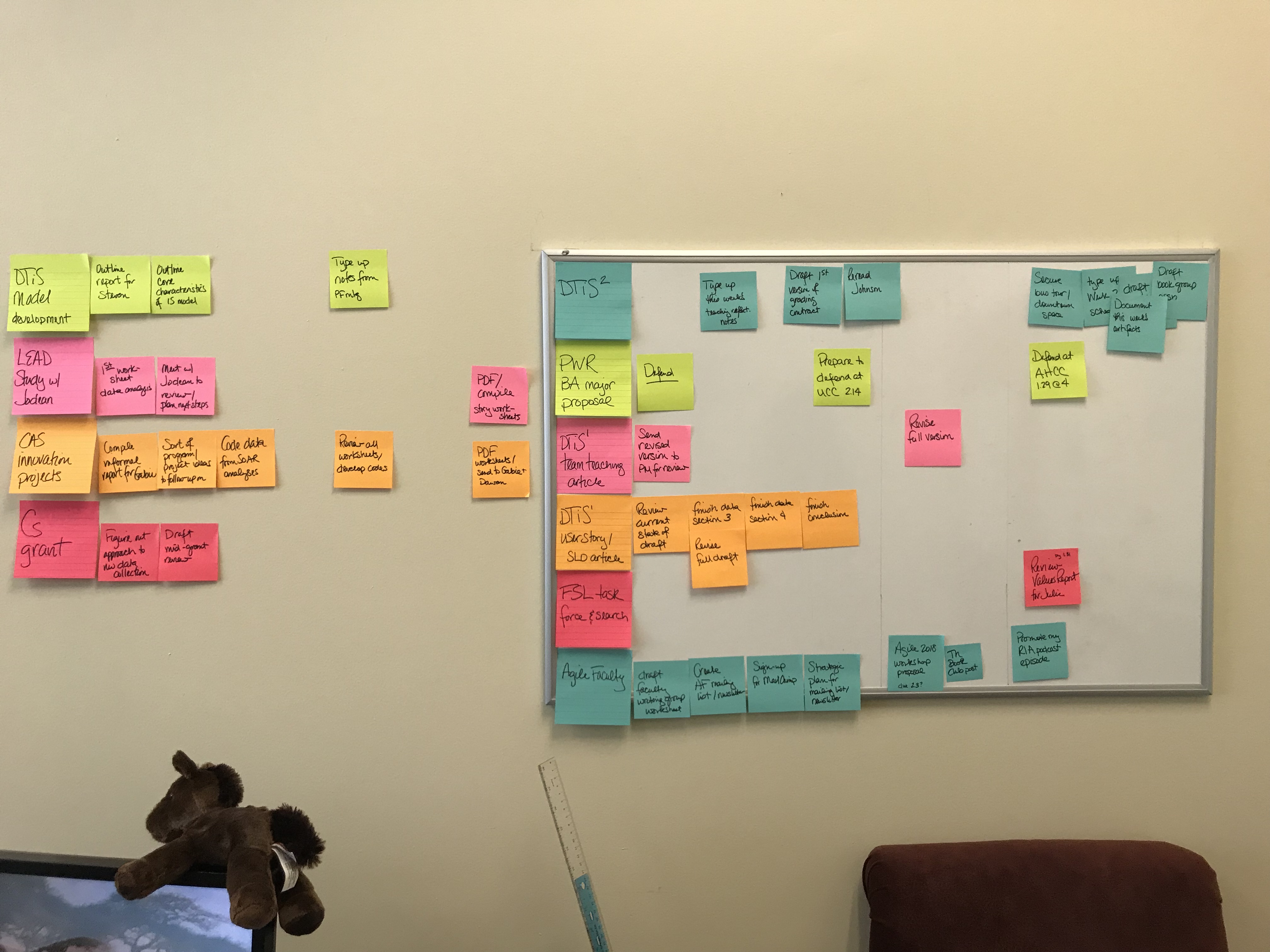
Why have I never set up a board for all aspects of my faculty life? Because, look at it; it’s scary. And after I took this picture, I realized there aren’t rows for two book projects I’m working on. I regularly write up lists of everything I’m doing in terms of teaching, service, and research because I like (or need to) see where my time is going in the hopes that I can prioritize and know what I can drop if necessary, either to make room for something else or for breathing room. But I’ve never moved this to a board because I didn’t really want to see it; sticky notes would make it real and messy and overwhelming.
A full board never made sense to me for teaching or service either. For regular classes, the board seems like overkill; I’d just keep moving the same sticky notes for “plan Tuesday’s lesson” and “grade five papers” from WIP to Done to WIP. And my service activities were less formal and more sporadic, heavy sometimes and nonexistent at others. Weekly to-do lists made more sense for both of these.
But after a discussion with my husband about my priorities, I had to agree that I needed to see the big stuff in one place for a while, especially as I’m trying to make space for running this blog and growing Agile Faculty.
One backlog per product, right? Product isn’t the right work for a human here, but my work life is one big holistic project with many features. So my life project should have one backlog.
I have set up my full Scrum board in my work office, which I’m admittedly in far less in the Spring since I’m in the Studio most of the time, but it’s there, and I can update it a couple times a week. I’ve included work on everything related to my Studio program from teaching to administration to funding, the two articles I worked on during the January #AFSprint challenge have still need some attention, the student life work group since were writing some reports, the major proposal, and work on Agile Faculty.
This board doesn’t contain everything that would be written on a full list of what I’m connected to (which I did this morning in my trusty Erin Condren notebook), but it includes the major things competing for my time and attention this month. I have two conference presentations and a keynote coming up in March (which, again, aren’t even on this version of the board yet. Sigh.), so the board priorities will shift as those get closer. All of the other things that haven’t made the board because they are too small (like committees that only meet twice a semester) or not fully on the radar yet (articles and proposals I want to write but haven’t started) are safely written in a Google Doc, waiting for their time to come – like the articles that will soon be coming in for a special issue I’m co-editing and the proposal for an edited collection I’m waiting to hear from the publisher about. Their time will come.
How do I feel about looking at this more holistic board? Less scared that I thought I would, but still intimidated. In some ways, it gives some of the projects more heft, a reminder that these teaching and service responsibilities are important too. It’s also helpful because things are always moving on the board. I fully admit to often losing the plot on my writing activities during a semester. When that happens, a mysterious black hole occurs over my board, and I magically cannot even see it anymore. That won’t be the case now. I’ll be interacting with the board more regularly, which will force me to see my priorities and figure out ways to actually respect my time, commit to what I care about, and focus on what’s important as i strive to maintain my own faculty vitality.
I’m going to see how this (giant) Scrum board experiment goes, and I’ll report back every once in a while on my progress. How are you using your Scrum board?
 rebecca pope-ruark