

What portion of our days to we spend in meetings? As faculty we attend department and college meetings, committee meetings, meetings with students, meetings with research peer or our writing groups, professional development meetings, etc. But how many of those meetings are well run…or even necessary (certainly meetings with students and research peers are at the top of the necessary ladder)? how many of these meetings last for hours when a carefully planned agenda and rules of conduct could have cut the meeting time at least in half, if not more?
 While PMP-style mangers love to have meetings, others can find meetings toxic – who hasn’t sat in on a meeting that affected the rest of the day or even week (or required a stiff drink to celebrate surviving the meeting)?
Here’s an interesting post from the Culture Hacking blog titled “The simple question that will increase meeting effectiveness.” The key point is that every meeting should be held to address a specific question and only people who can help answer that question should attend the meeting (sounds similar to Steve Jobs’ philosophy of kicking people out of meetings who didn’t absolutely have to be there to engage).
This reminds me of the question approach used during Daily Scrum meetings used in software development companies operating within the Agile Scrum methodology for project management. Every morning the team gathers for a 15 minute meeting. They stand in a circle (standing encourages short meetings) and typically each answer three questions: what have I done since our last meeting? what will I do today? what challenges might I face, or what might I need assistance with? These quick “stand-up” meetings encourage collaboration, accountability, and engagement by every member of the team. And the 15-minute time box encourages brevity and focus.
I use Daily Scrum meetings in many of my student group projects, and I’m also wondering how we might use the question-agenda idea in both the classroom and in helping our students coordinate group project work. I have in the past set up my syllabi, primarily in core, content-heavy courses, around questions we would explore that day in discussion. That works well and seems to help students prepare more effectively and take better notes.
But I can see how this would be really valuable in student group work as well. Students often approach group meetings with no plan or agenda, only a scheduled time to meet. In helping our students self-organize their work, we can encourage them to set agendas for their meetings based on one question they will answer. How might this help students better prepare for the meeting? How might this help them to be more effective collaborators or to accomplish more goals incrementally? Seems like a solid Agile approach worth pursuing.
How might using the question-agenda approach be useful for your meetings or your student group projects? For committee meetings?

This is the fifth post from a series I wrote in 2012 about writing and publishing with undergraduate students. I’ll be publishing this series every other Thursday over the summer. For more recent research and resources, visit the new International Journal for Students as Partners and a special issue of Teaching and Learning Inquiry that I co-edited on students as co-inquirers.
 When analyzing and writing up SoTL data with my students, ethics has been the most important and challenging aspect of the work. Ethics in SoTL work is an important issue anyway – how can we study our students without taking advantage of them or privileging those who agree to take part in the research? The foundations of SoTL say that we are the experts in our own disciplines and classrooms, so we are best positioned to study the effects of teaching practices and the process of learning in our own classrooms. This can seem at odds with our graduate training and our respect for IRB and human subjects regulations. Empirical data collection with human subjects obviously requires careful attention to research ethics, and the empirical nature of SoTL is one of the things that differentiates it from teacher research or scholarly teaching.
When collecting SoTL research with or without your students, here are some simple measures to take to ensure ethical data collection and treatment of subjects. The first two tips are for SoTL projects in general:
Carefully create and submit your IRB application early. Some IRB’s, especially at more traditional research institutions, are still learning to deal with the challenges and requirements of SoTL research, so it might take more than one pass to get the application through. My university is a teaching institution, but we of course went through the same challenges. Here is the statement that our Center for the Advancement of Teaching and Learning posted to help both researchers and IRB members navigate these waters. For us, anything that records students, voice or video, is still a challenge, and those methods will require and extensive justification. But methods that are part of the class structure are much easier to support. Here’s a good page with a collection of sample methods.
Ask a colleague to handle the informed consent forms. SoTL isn’t really about control groups and sterile research practices. If I’m the expert in my classroom, and I want to try something based on my observations that I think will make a positive impact on learning, I’m not going to offer that benefit to some students but not others. To be sure that I don’t think of my students as research subjects during the semester, I ask a colleague to attend my class early in the semester for about 20 minutes. I step out, and my colleague explains the study, takes questions, collects the consent form, and seals the envelope. That envelope then lives in the colleague’s files until after my grades have been submitted for the semester. This ensures that I treat every student the same way throughout the course regardless of their participation in the research study.
Develop data collection instruments with your student co-researchers. In the last post, we discussed the process of creating research questions with the students; creating the instruments is equally important. This is an opportunity to help students determine the best means for collecting data to answer the research questions we developed. This is also the opportunity to discuss the ethics of the data collection and interacting with their peers as research subjects. I frequently try to stick to methods that are somewhat less personalized like a survey; though interviews and focus groups might be equally as appropriate.
Include the student researchers in the process of drafting the IRB application. The application is the first opportunity to really codify the research plan and talk through not only how the data will be collected, but also how the researchers will engage with participants. Student researchers might not understand or even consider the ethical implications of research, so this is a great teaching moment. I often work in two phases with my IRB applications – I will submit one as the sole researcher before a class that meet the attributes of my research agenda, and if something special or interesting outside or tangential to that agenda occurred in the course, I will invite students to collect more data and write with me the next semester.
Discuss research ethics regularly. In my most recent foray into writing with students, I was faced with a perplexing ethical dilemma that caught me by surprise for some reason. I had collected, with IRB support, 10 reflections from each student in the class we were studying. The student co-researchers and I then created and survey that we sent to students in the course the next semester. We also used our own experiences and observations as the third aspect of our triangulation. Once we decided what we were looking for in the study, in this case student motivations to collaborate well with peers and community partners in a service-learning course, I had to code the student reflections. I took on the coding myself because I was uncomfortable sharing those reflections with the students.
As I was coding, I realized that it was going to be pretty easy for the student researchers to figure out which of their peers said what in their reflections anyway. After talking though the ethical issues with a wonderful mentor at CATL, I decided to use the blinded data, muddy though it was, to avoid putting the student researchers in a particularly awkward position. We promised to make it clear in the write-up how the data had been coded and why we had chosen that path. We overdid it in the data by constantly attributing the data analysis to me (“In RPR’s findings in the reflections” – times 50), but we ended up with the occasional reference and a good footnote in the version we submitted for publication.
Working with student co-researchers, like any SoTL work, has its own ethical challenges. Identifying and thinking through the challenges with the students and developing responsible solutions is part of good scholarship. In the next post we will look at some strategies for writing up the data for your target journal – especially the issue of voice.
This is the fourth post from a series I wrote in 2012 about writing and publishing with undergraduate students. I’ll be publishing this series every other Thursday over the summer. For more recent research and resources, visit the new International Journal for Students as Partners and a special issue of Teaching and Learning Inquiry that I co-edited on students as co-inquirers.
One last post before we start talking about how exactly to write with our undergraduate co-authors…because before we can write we need to know what to write about and who to write it for. In this post, we’ll explore how to work with your student co-authors to develop research questions you all care about that will guide your data collection and writing as well as think about possible journals to target for publication.
Developing Good Research Questions
Research questions can make or break a research project – too broad and we collect far to much data to analyze successfully; too narrow and we have too little data to say anything meaningful. SoTL research questions have the added challenge of being about our own students and, therefore, being very personal. Last year I wrote two articles for a pedagogical journal in my field about SoTL and conducting SoTL research because I think this type of work is a natural fit for business and professional communication. While researching those articles, knowing that my goal was to encourage others to begin a SoTL research project, I spent a lot of time thinking about how to develop good research questions and a good empirical study. In synthesizing articles about how to “do” SoTL, I found that good SoTL research questions have a few similar characteristics. Good RQs are
- empirical – the questions lend themselves to research that can be planned, conducted, and assessed. SoTL isn’t ad hoc.
- descriptive – According to Pat Hutchings the most basic SoTL questions are “what works?” and “what is?” So good questions help us identify successful teaching and learning as well ad describe teaching and learning in different contexts.
- of broad interest – While SoTL researchers conduct research in their own disciplinary classroom, good researchers address questions that can be of interest to others in different disciplines. So good questions might help us learn something that can be applied beyond just our own classes.
As I’ve written earlier, I’ve published one article with student co-authors and am in the process of completing another right now. I approached the research questions differently with these projects. With the first article, I already knew what it was I wanted to know about student learning in the publishing class – I was interested in how the use of Scrum project management strategies affected student learning and activities during the full semester service-learning book project.
When I invited the students to join me, I told them that this was my interest for the article. Before our first meeting, I encouraged the students to freewrite about their experiences in the course, especially about Scrum, and then when we met we used those ideas to begin our discussion and refine some ideas for how to frame our research questions. We found common threads of interest about how students feel about collaboration in the classroom, how students build identities as collaborators and as professionals, and how experiences like our publishing class can impact those things. Ultimately we presented the following research question to the readers of our article: “How might instructors design experiences that not only help students learn about the process of effective collaboration but also help them build identities as engaged collaborators despite the individualistic, competitive environment inherit in a grade-based academic system?”
The second time around, I was less interested in the specific instrument of collaboration, but still interested in how the service-learning experience in the grant writing class might have helped students learn. I knew something special happened in that class, and I wanted to figure out what it might have been (plus I knew I was going to use the data I collected about the Agile strategies used in that class in a different article, so I didn’t want to double-dip inappropriately. When I invited the three students to join the project, I was clear that I was unclear about what our research questions were – we spent the first 3 weeks of our time freewriting and brainstorming about the class to see what might have been different about the experience than other classes. Again, we used those ideas to guide our conversations and ultimately lead us to explore issues of motivation and collaboration in the grant writing class. So our overarching research question became “what intrinsic and extrinsic motivations were at play during the grant writing experience and how did those motivations affect students’ performance and dedication to the project?’
From both of these questions, I then worked with my student collaborators to develop a survey and focus group questions that could be used to collect more data from their peers in the courses. In the grant writing project, I also had IRB approval to use student reflections as data as well (that’s a whole ethical can of worms we can discuss next time). Once we had questions, we developed our data collection instruments, earned IRB approval, and collected data for the project as any other set of researchers would. But before we talk about writing up that data, we need to think about one more thing…
Choosing a Target Journal
As with any article, having a target journal in mind allows the authors to work with a stronger sense of purpose and audience at a high level and, at a lower level, to structure the piece according to the specific guidelines and style sheet of that journal. Part of the faculty member’s role in this co-authoring process is to share expertise about publication venues with the student co-authors so the team can make a collective decision about which journal to target. So what journals might be open to SoTL publications co-authored with students? Look into journals from three categories to get started.
Disciplinary Journals – If your field is like mine, a range of journals exist to build knowledge in different facets of the discipline. You know which journals might be more receptive to this work than others that are perhaps less pedagogically inclined. For example, in my field of professional communication and rhetoric, I can name 6-8 journals that would be standard publication venues for my scholarship. Because my field is very pedagogically grounded, more than half of those journals might be interested in a SoTL study co-authored with undergraduates.
Not sure if you should pursue a disciplinary journal? Just email the editor a brief query. I emailed the editor of a pedagogical disciplinary journal when I started thinking about an article about the grant writing course, explained to her the general idea, and asked if she might be interested is seeing an article like this submitted. She was enthusiastic about the piece, so after comparing this journal and a service-learning journal, my co-authors and I decided to target it based on the editor’s enthusiasm.
SoTL Journals – Scholarship of Teaching and Learning journals are a natural place to start when considering a publication venue with your student co-authors. SoTL journals value the pedagogical scholarship you are most likely doing with your student co-authors and already accept that publications co-authored with students are meaningful scholarly endeavors. You don’t have to make an argument to a journal editor explaining why the research is connected to the journal mission or why undergraduate co-authors are competent researchers. As long as the research is empirical and ethical, scholarly, and relevant to those interested in SoTL (not just your discipline), a SoTL journal will likely consider the piece for publication. Here are some journals to explore:
Teaching and Learning Inquiry
International Journal of the Scholarship of Teaching and Learning (IJ-SoTL)
Journal of the Scholarship of Teaching and Learning (JoSoTL)
MountainRise
College Teaching
Journal on Excellence for College Teaching
Teaching and Learning Inquiry: The ISSOTL Journal
Teaching and Learning Together in Higher Ed
Service-Learning Journals – This category is obviously more limited the others, but service-learning experiences build interesting bridges between SoTL and disciplinary work. If you do service-learning and think your disciplinary journal might not be interested (or think that a larger pedagogical community can learn from your work), consider one of these journals:
Michigan Journal of Community Service Learning
The International Journal of Research on Service-Learning and Community Engagement
Partnerships: A Journal of Service-Learning and Civic Engagement
Journal of Service-Learning in Higher Education
Bonus Journal! – Perspectives on Undergraduate Research and Mentoring (PURM) is an online journal that, rather than publishing the primary results of undergraduate research, instead publishes articles about the process of undergraduate research and researching with undergraduates. If you developed a new strategy for working with undergraduates or worked with students to overcome a research issue, and you are interested in sharing that experience, PURM is the place for you and your student co-authors to submit a second process-based article so that others can learn from your experience.
Wrapping It Up
Once you have developed your research questions and resultant data collection methods as well as chosen a target journal, the research truly begins with your undergraduate co-authors serving as true collaborators. In the next post, we’ll talk about considerations for collecting, sharing, and analyzing data with students. I’ve recently dealt with some interesting ethical challenges while doing this work and look forward to your input on these issues. Thanks for reading!

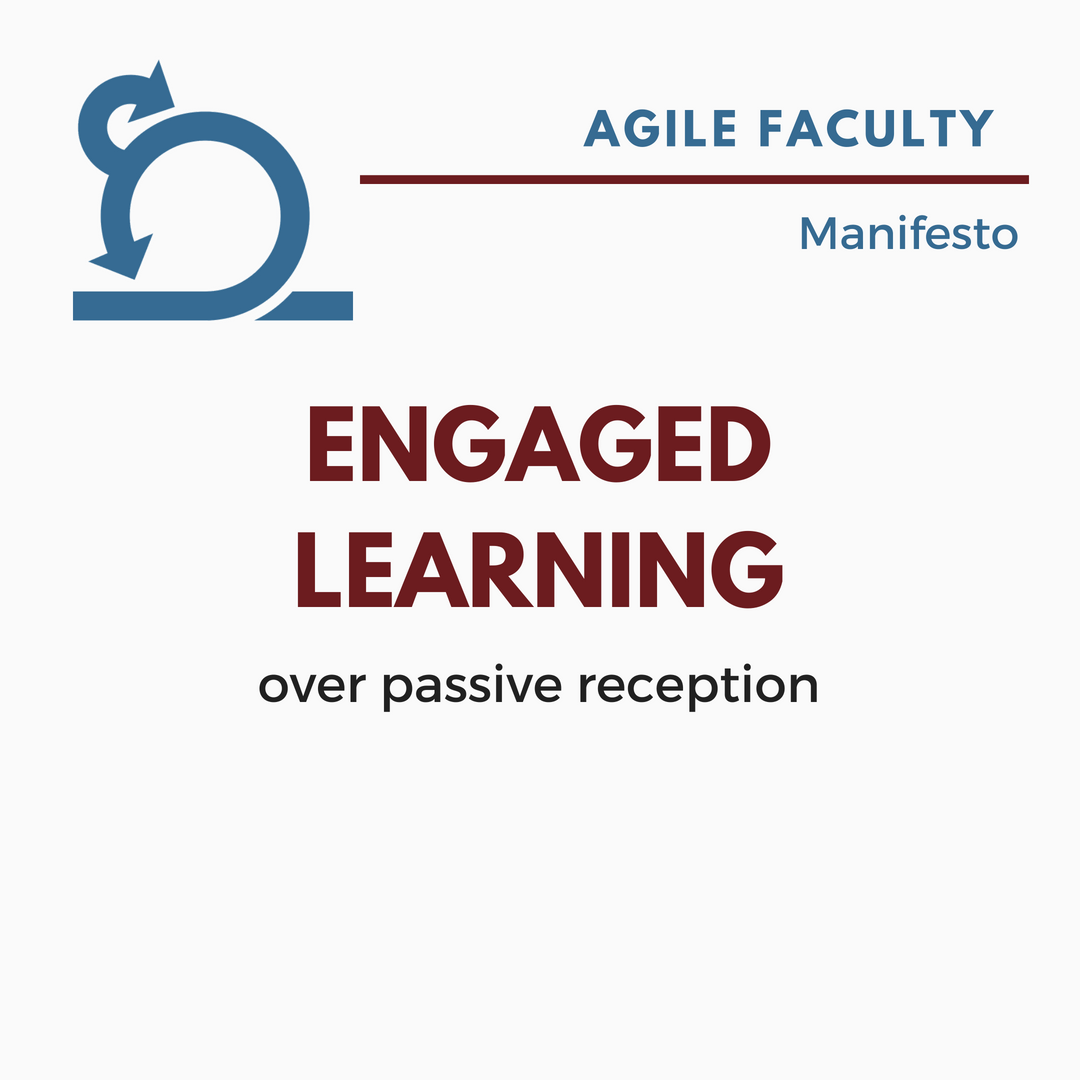
This post is part of a summer series looking at the Agile Faculty Manifesto. Read the Manifesto in this series preview post or in Chapter 1 of the book. This post explore what it means to focus on engaged learning.
Agile Faculty value engaged learning over passive reception.
Some of my classes seem like chaos. If you came in to a class period near the middle of a project, you might see students running between small groups, disappearing into the back room with sticky notes, staring at their computers intensely, calling contacts or community partners, even asking me to stop hovering. Usually at this point, I’m relegated to the back of the room until someone calls me over or asks a question. In this course, the project is the content. And the chaos is by design.
I teach courses in professional writing and rhetoric, composition, and design thinking at liberal arts-grounded university with a deep commitment to engaged learning in all forms at the undergraduate level. I feel supported in my pedagogy to engage students with the complex problems faced by real audiences in our community.
The majority of my upper-level professional writing and design thinking courses are project-based service-learning experiences designed to keep students a little off balance (check out the blog created by the students in the second pilot of the Design Thinking Studio in Social Innovation). Not enough that they feel unsafe, but enough that they can try something, get feedback (which they can take or ignore), succeed or fail, deal with it, and get back up to complete a strong project. I get dinged in my course evaluations consistently for the measure of having an organized course, but I’m good with that (and so are my chair and dean). But I believe students need practice dealing with uncertainty, the kind driven by an unclear problem, a complex audience, a lack of measure for success. And because the content of my courses really is the process of communicating and thinking effectively, the pedagogy makes sense – I don’t have a ton of content to cover that students will need before they can enter the next level of content-driven course.
 Honestly, college-aged me would have completely avoided professor me and my courses. I teach the way I do for that reason. I preferred lectures and readings, listening to others discuss a topic and then writing about it later. Hands-on learning was frustrating, and collaborative projects were maddening, largely because I didn’t trust anyone with my grades. So this entry in the Agile Faculty Manifesto is also close to my heart. I’m reading Susan D. Blum’s anthropology of American higher ed, written through the lens of her institution, Notre Dame. She argues, like many before and others to come, that the traditional system of higher ed is a game students play for the credentials not the learning.
They (and we) are always learning experientially, but perhaps not as often in the classroom as could be if we committed to varied engaged learning strategies, even those that completely transgress the standards of seat time, semesters, textbooks, and grades. This might be easier said than done in different contexts, such as large lecture sections, for example, but the Scholarship of Teaching and Learning literature is rich with examples of how to implement active, engaged learning in classrooms and programs. Agile Faculty believe in engaged learning – after all, how will students build that well of phronesis needed to make good decisions about future actions without practicing and applying? (See the post about simplicity for a little Aristotle.)
Active and engaged learning pedagogies also require faculty members to be more flexible, let go of some control in the classroom so students can teach themselves and each, perhaps learning from clients or community partners as well. we might come to rely on more just-in-time teaching during engaged learning assignments. In building up students’ resilience, we build ours as well.
Learning by definition cannot be passive. How do you interpret engaged learning in your own work? How do you approach active learning? What works in your field?
This post is part of a summer series looking at the Agile Faculty Manifesto. Read the Manifesto in this series preview post or in Chapter 1 of the book. This post explore what it means to focus on quality.
Agile Faculty value quality of work-life accomplishments over quantity of achievement.
 As I write this post, we are a week past Elon’s graduation ceremony and heading into the summer. And also as usual, I’ve been creating, planning, and overthinking my summer productivity goals since early April. My backlog of possible projects has been staring at me for months now. This is common for me. I’m not sure if it comes from a need to see all the projects I could possibly work on, required or not, in one place so I can make better decisions about my time or if it comes from that place inside me that says I must always be working, striving, achieving. Maybe it’s both. Regardless, this preliminary project backlog clearly focuses on a quantity of professional projects. It says nothing about how I value of any of these projects…or about the life part of work-life accomplishments.
I think we each have a tipping point, the point where quality goes down as quantity goes up, and that point is different among faculty*. The Agile Faculty Manifesto includes this point as a reminder that I/we cannot do everything at once, so we must prioritize and, when possible, follow the flow with the projects we value most while still meeting goals and deadlines for projects less in our control. The piece about “work-life accomplishments” is also an intentional reminder that work is part of life and vice versa.
 Quality and quantity might be adversaries for many of us, especially if promotion guidelines are unclear. Faculty in arts and humanities disciplines, as well as social scientists who rely on observation-heavy qualitative methods such as ethnography, might less on quantity due to the very nature of their research or artistic products. Those in highly collaborative environments, like labs, might produce more research with more hands to undertake the writing.
This point in the Agile Faculty Manifesto also includes an intentional nod to life quality. I personally have trouble with the phrase “work-life balance” because work is a key part of my life and life impacts my work. In the book, I use the term “work-life integration” instead. Regardless of whether you think in terms of balance, integration, or even alignment, this frame of references will impact your valuing of quality and quantity, which will certainly flex over time during a semester, academic year, careers, etc.
Do you know where your quality/quantity tipping point is? If so, how did you come to that realization? How do you think about the balance between quality and quantity in your work and life? Do you think about work-life balance or integration? How does that impact your approach to your work?
*I recognize I come from a place of privilege as a tenured, full-time, childfree faculty member who has the luxury of not having to teach in the summer. Those of us with this privilege must work to better support our peers without this luxury.
This is the third post from a series I wrote in 2012 about writing and publishing with undergraduate students. I’ll be publishing this series every other Thursday over the summer. For more recent research and resources, visit the new International Journal for Students as Partners and a special issue of Teaching and Learning Inquiry that I co-edited on students as co-inquirers.
Nearly every Monday this semester, (well, in 2011) my writing partners and I have met in my office at 10am, laptops on, Dropbox open, discussion flying. We are writing an article about student motivations in a service-learning class. After about 10 weeks of stealing research and writing time in between classes and meetings, we have a solid draft that we are now heavily revising and editing, each person commenting on the others’ sections, making suggestions for improvements and asking questions when information or connections seem to be missing.
This might sound like your writing groups, but in this case my collaborators are three undergraduate students. These three young scholars took the class last Fall, and we have worked this semester to determine research questions, collect extra data, draft a scholarly article, and hopefully have it accepted for publication in a disciplinary journal.
How do you determine what teaching and learning experience make good opportunities for research with undergraduates? How do you develop solid, empirical SoTL research questions? How do you select students to join the research?
The answer to these questions is honestly “in the usual way.” But of course the usual way is complicated when the lead researcher/author also serves as mentor to new scholars who most likely do not plan futures as academics. In this post, we’ll cover the first two questions, and next week I’ll address developing solid SoTL research questions. This particular post will draw more on my personal experiences than the first two, not because my way of approaching the process is superior to others, but simply a way to start you thinking about what strategies might work for you.
Determining the Research Opportunity
Like most research opportunities, ideas spring out of questions and experiences, successes and failures. We’ve all had courses that were almost magical – everything just comes together in the right time and right ways. But of course we’ve all also had inexplicable failures – groups that never gel, students who don’t engage, assignments that fall flat. Sometimes those best and worst experiences can happen in the same course with the same assignments at different times with different students.
Randy Bass argued early in the SoTL movement that we often consider “problems” exciting in our research but taboo in our teaching. Yet we all have questions about our teaching. Why do some students seem to grasp a concept immediately and others lag? Why does one type of assignment work in one context but not another? What motivates student performance in a traditional course section vs. a service-learning or problem-based learning section?
In the two instances that I’ve decided to explore writing an article about a course with undergraduates, I chose to write about unique experiences that already fell within my personal SoTL research agenda. I am interested in student collaboration strategies, extended client-based and service-learning experiences, and the possible advantages to using Scrum project management strategies in my courses. In both cases, I was already collecting data for my own research and by the end of the courses had additional questions about student learning and motivations. So inviting students from the courses to help me explore these additional questions was a natural extension of my on-going work.
Not everyone is in the same position, but think about courses that worked well for you (or didn’t), particular assignments that seemed to encourage learning better than others (or not), or general questions you have about the learning experience in a particular course. Choose a course or assignment that you really want to learn more about so that you can sustain and share enthusiasm with your student co-researchers during the project. Once you invite students to participate, the commitment is made, so pick something that you are really curious about; that might be relatively easily researched via post-experience surveys or focus groups; and that might contribute to the growing body of SoTL research.
Choosing Student Co-Researchers
Though it might seem to make sense to talk about developing the research question as the next step, consider instead inviting students into the process before that question is fully formed – after all, developing the RQ is an important and exciting part of the research experience that helps ease the student co-researchers into the inquiry team mentality. In the last post, we discussed the value of student voice(s) in research, and that voice should extend to developing the inquiry as well.
When you think about choosing student co-researchers, the obvious choices are the stars – the students who shine in class, seem to really get the disciplinary perspective, and would be honored by the invite. These are often the students we see ourselves in. When we include these students in the project, we know that we’ll work well together and that they will perform well in the experience. On the flip side, these are the students who are often getting the most opportunities to extend their education and might take on the project more out of the desire to add resume fodder than genuine interest.
A second group of students to consider are the ones that show potential but might not have been the A students in the class. These are the students who might have struggled more but who also exhibited some level of determination, engagement, and commitment. These students might care just as much, if not more, about the discipline than the A students but might not be offered the same opportunities. Maybe these students just want an opportunity to shine or to approach their education from a different angle. Might these students be a risk? Possibly, but sometimes the risk is really worth it.
A third group of students to consider are the convenient ones. I know how that sounds, but sometimes time and availability are really important. When I decided I wanted to write an article with some students about the use of Scrum project management strategies in a very successful iteration of my Publishing class, it was the end of the Spring semester, and I knew I’d be busy collecting data for another project in the fall. So I thought about the students in the class, considering who might be interested in working with me, who had a unique experience in the course, and who might be in the area over the summer. The three young women I asked were excited to participate and worked with me all summer to submit the article before fall semester began.
For the article I am currently writing with students, I used the same process (Update: this article was published in 2014). I thought about students who might be interested, who had different experiences in the course, who might benefit by experiencing the research process to grow their confidence or disciplinary skills, and who would have time during the semester to commit to the work. I also talked with a colleague about my preliminary choices, just to bounce the idea off of a peer and think about what students might work well together. I invited three young women to participate, and all were excited about the opportunity (yes, my co-authors have all been women, but this is representative of our student population in my program rather than any bias on my part. Only three men took part in the two courses mentioned here.).
Do you need to offer incentives for students to participate? That probably depends on the students. In my experience, the students are just happy to be asked and to have the opportunity to be published with a professor. During the Publishing article project during the summer, we worked at my apartment usually, and I provided food and snacks for their time. On a few occasions I took them out for a meal to discuss our revisions. This time around, since we were working during the semester, I offered options for credit. One student chose not to take a credit option since she was a part-time student finishing up her degree, but two others signed up for an advanced studio course I teach, and the project has been part of their work for that course.
Moving Forward
Once you have an idea for a project and a student or group of students in mind, the fun part of the process can begin. Next week, we’ll discuss developing appropriate SoTL research questions with your students for these projects and consider possible publication venues for the work.
Until then, what suggestions do you have for choosing a project or co-researchers? What challenges do you foresee getting the process started? What ethical questions should we be considering when beginning these types of projects?
This post is part of a summer series looking at the Agile Faculty Manifesto. Read the Manifesto in this series preview post or in Chapter 1 of the book. This post explore what it means to focus on simplicity.
Agile Faculty value simplicity over complexity whenever possible.
Higher ed, even at its best, is a complicated environment. Levels of bureaucracy at department, college, and university levels and the often-felt tension between faculty and administration can make navigating an academic career tricky business. Faculty governance can be a blessing and a curse as well; most of us have probably been in meetings that exemplify this. Juggling research, service, and teaching can be like trying to put together a puzzle when the individual pieces keep changing size.
The original Agile Manifesto is accompanied by a set of 12 principles that extend and ground the commitments stated in the Manifesto. Here is one of my favorite of these principles:
Simplicity – the art of maximizing the amount of work not done – is essential.
I think about this one frequently. What does it mean to maximize the amount of work not done? The statement does not recommend putting forth only your minimum effort or being lazy. One way to interrogate the statement is to flip it – simplicity is the art of minimizing the work done. This framing suggests we should strive to do what adds the most value and/or focus on the most important pieces of the work we value rather than overcomplicating what we do.
 For example, many faculty members might feel they cannot write a good lit review for a research article unless they have read everything about it. I think of committee and department meetings when answering a question about a future action ends up requiring multiple surveys, reading every report ever written on the subject, polling folks at peer and aspirant institutions, interviewing everyone even tangentially related to the question (OK, that is an exaggeration, but perhaps not by much in some cases). I also think of some of my early assignments with their four page assignment sheets and multiple steps and requirements that confuse students as to what the point of the assignment is.
Faculty life is not simple and never boring. How can we simplify the work we (most want) to do by maximizing the work not done? One way might be to examine the way we break down big projects into smaller tasks and to assess which of those tasks are truly necessary to accomplishing the goal. Are there tasks that you are doing simply because you’ve always done it that way but that are not essential to your process anymore? Might conducting a design activity or starting with a daily Scrum at the beginning of a committee meeting determine the most important things to discuss in that time. Are their better ways to streamline an assignment that still achieves the learning goals without the four page assignment sheet? (I’m reminded of the saying, “The more you use the reins, the less they use their brains,” which seems just as applicable to humans as to horses).
The more you use the reins, the less they use their brains.
The principle as written states that maximizing the work not done is an art. As an Aristotelian, this warms my heart. Aristotle defined “art” as techne, craft, the intellectual virtue of being able to put knowledge into practice in order to produce something. But I would argue that his third intellectual virtue, phronesis, is even more applicable here. Phronesis can be defined as practical wisdom, knowledge accrued over time from learning and interaction that can be called upon to make rational decisions about future actions (this is all in Nicomachean Ethics if you are craving some Aristotle this summer). Phronesis is required to simplify faculty work, to make good decisions about how to act on a current or future project by understanding one’s own practice and maximizing the best parts of that practice to be successful.
How can you choose simplicity over complexity? What actions or processes might you simplify? What processes do you use to maximize your time and simplify tasks?
This is the second post from a series I wrote in 2012 about writing and publishing with undergraduate students. I’ll be publishing this series every other Thursday over the summer. For more recent research and resources, visit the new International Journal for Students as Partners and a special issue of Teaching and Learning Inquiry that I co-edited on students as co-inquirers.
What exactly does it mean to include student voices in Scholarship of Teaching and Learning (SoTL) research? Where does the concept come from, and how can student voices be included in our SoTL work? Does it mean we just use students as research subjects who we quote, or is there more to it than that?
When I noted at the end of my first post on publishing with students that we would discuss the idea of student voices, Peter Felten responded and helpfully raised an interesting point – there is a rather contentious debate among scholars as to which term is more appropriate for this work – “student voice” or “student voices.” According to Peter, “voices” plural is the preferred term of scholars in the US like Carmen Werder, but the term originated in the UK as “voice” singular, not implying a unified voice but instead a tradition in the research. For the sake of this post, I’ll align with the US scholars and use “student voices.”
Why Student Voices?
So, how do student voices play into SoTL? Well, the better questions is “how can we study teaching and learning in higher education without student voices?” After mining at least 15 different definitions of SoTL, Potter and Kustra compiled the following definition: “the systematic study of teaching and learning to understand how teaching (beliefs, behaviours, attitudes, and values) can maximize learning, and/or develop a more accurate understanding of learning, resulting in products that are publicly shared for critique and used by an appropriate community” (p. 2). Students are noticeably absent from this meta-definition, putting the emphasis on the teacher-researcher and only obliquely implying students are present as someone who must be “learning” in this equation.
While the omission may have be unintentional, it is still telling. As scholars work to legitimize SoTL in the eyes of the academy, we have had to be sure to emphasize that the work is empirical, intentional, and peer reviewed as well as ethical. Adding students as co-authors rather than simply research subjects just might make that argument a little more difficult to make to traditional P&T committees.
But as the undergraduate research movement has grown in the last 20 years along with SoTL, it only makes sense to include the perspectives of the learners in the design, execution, and sharing of research on teaching and learning. This work is not necessarily new but is only now really gaining traction, perhaps because SoTL is maturing as a legitimate research area. One of the early clusters in the Carnegie Academy for Scholarship of Teaching and Learning (CASTL) sponsored by the Carnegie Foundation for the Advancement of Teaching focused on student voices. This online resource shows the results of this work at the University of Maryland. Illinois State University (here as well) and Elon University also engaged faculty and students in supported efforts to include student voices in SoTL research.
How is Including Student Voices Different than Studying Student Learning?
Traditional educational research has always studied student learning with methods consistent with the goals of that field. SoTL is different in that the research is conducted by scholars in their own fields rather than by experts in educational research (which is also contentious). After all, we are experts in the ways teaching and learning work in our fields. When we study teaching and learning, we naturally must study instructors and students. But including student voices goes far beyond simply including student quotes in our research articles.
In a special issue on student voices in SoTL in Teaching and Learning Together in Higher Education, guest editor Marilyn Cohn noted, “the study of classroom pedagogy through the Scholarship of Teaching and Learning and action research leads to increased awareness of the value and power of learner inclusion and empowerment. The closer … faculty look at their classrooms, the clearer it becomes that meaningful and lasting learning requires dialogue, collaboration, and partnership with students.” Students can be involved in SoTL research as equal partners with scholars in developing research questions, determining appropriate research methods, collecting and analyzing data, and publishing and/or presenting this work at appropriate scholarly venues.
One of the leading voices (no pun intended) in this work is Carmen Werder at Western Washington University, co-editor of Engaging Student Voices in the Study of Teaching and Learning. In the video below, Carmen and her co-editor Megan Otis discuss the merits of including students as SoTL researchers:
As Carmen notes, “it only makes good sense if you are doing research on teaching and learning that you bring students into it…it’s not a luxury anymore, it’s a necessity.”
Building on this foundation for the rest of the blog series, we’ll move forward with the practicalities of adding the voices of student researchers drawing on my experience and those of others in the field. I’ll try to include student voices in this process as well. In the next post, we’ll explore how to identify SoTL research questions and students co-researchers for a project.
Until then, what are your thoughts on including student voices in your teaching and learning research? If you have worked with student researchers, what did their voices add to the research and writing processes? What are some reasons you have or might consider adding student voices to a SoTL project?
Do you have a personal or professional manifesto? Seems lofty, right? Maybe even a little pretentious? I went through a phase during my MA program in which I put my “mission statement” on every resume rather than an objective – I still cringe thinking about it now (and use it as an example of what not to do in job materials). But a mission statement isn’t a manifesto, a call to action, rally cry to shared values.
During the original Snowbird retreat in 2001 when the founders of what we now call Agile met to come to terms with the state of software development and call for change, one result was the Agile Manifesto:
Individuals and interactions over processes and tools.
Working software over comprehensive documentation.
Customer collaboration over contract negotiation.
Responding to change over following a plan.
That is, while there is value in the items on the right, we value the items on the left more.
The items on the right are typical of industrial Taylorist principles of work and what the Snowbird “organizational anarchists,” to use Jim Highsmith’s words, were rallying against. They envisioned a more humanistic work process that was flexible, adaptable, and human-centered. They were careful to say that they weren’t throwing the things on the right out, but that they wanted the things on the left to be the foundation for the future (Often people who react negatively to the Manifesto miss that last sentence. Technical writers, for example, might worry that the Manifesto seems to eliminate documentation, but the last Manifesto sentence makes it clear that is not so.).
While writing Agile Faculty, I imagined what a manifesto for Agile Faculty would look like. Here’s where I landed by the time the manuscript was due to Chicago:
Simplicity over complexity whenever possible.
Quality of work-life accomplishments over quantity of achievement.
Engaged learning over passive reception.
Responding to changing environment over maintaining status quo of academia.
Collaboration with students, colleagues, and communities over isolated productivity.
While there is value in the items on the right, we value the items on the left more.
 Over the course of the summer, I’ll be digging a little more deeply into each of these statements, and look forward to discussing them with you on Twitter – find me at @RPR_Elon to share your thoughts. I’m treating this version of the Agile Faculty Manifesto as a prototype that will change and iterate with feedback and discussion.
Here’s a graphic version of the Agile Faculty Manifesto to save and share.
And here are quick links to the already published manifesto blog posts:
Simplicity
Quality
Engaged Learning
 This post and the series of posts that follows over the next few weeks were originally written in 2012 on my first blog. I’ve kept them mostly intact while updating some of the links. I hope these posts will help you think about writing and publishing with undergrads in the future!
The idea of co-presenting at a conference or co-authoring a research article with a graduate student makes total sense to anyone who has ever worked with a graduate student. Faculty have ongoing research agendas; graduate students can participate in that work as a way to learn the ropes of research, collaborate with other researchers, manage time and data, figure out exactly what the data says, and share those results…because that’s what faculty do – build on and share knowledge.
This apprenticeship model, especially true in the sciences, allows grad students develop skills that will help them succeed in their own research and dissertation projects. The more we write in academic genres, the more feedback we get through peer-review, the more we become contributing members of the field. Realistically, that apprenticeship might come with a lot more indentured labor that actual mentorship, but most grad students know what they are getting into (we hope, and I’m blatantly ignoring the idea of courtesy citations and “you wrote it in my lab, so I get first author credit” silliness).
But what about undergraduate students? Many will not go on to graduate school and are not necessarily budding scholars or academics. As undergrads they may have limited experience with primary research and limited confidence in their abilities to create new knowledge in a field they have barely entered (frankly, I wasn’t sure I had anything original to contribute to my field until the 4th year of my PhD program). Why might a faculty member invest the time it would take to mentor an undergraduate student through the process of a collaborative research article at all?
Because it’s fun, and because they always surprise me with their enthusiasm for the opportunity, dedication to the project, and personal growth. They may grow as students and future professionals (here’s a cool story about an undergraduate who was included as a co-author on a Nature paper published by a Nobel laureate). But I also become a better teacher, mentor, and researcher when I co-author with my undergraduate students (which is consistent with the findings of this study of grad students who both teach and research). I have published one article with three of my students in 2011 and am in the process writing a second targeting Business and Professional Communication Quarterly with another set of three students (the article was ultimately published in 2014 here). Both of these articles were inspired by classes that I taught and that the students took, and both include original research after the conclusion of the classes.
In the weekly series of posts that follows, we’ll explore the “student voices” movement in the Scholarship of Teaching and Learning (SoTL), which provides theoretical and methodological grounding for writing about teaching and learning with your students (I co-edited an issue of the ISSoTL journal Teaching and Learning Inquiry on this subject in 2016). After that we’ll examine different aspects of the process such as choosing a project, choosing the student co-authors and thinking about credit, managing the time and project through active mentorship, strategies for avoiding awkward voice issues in the manuscript, and journals that support such scholarship to target. Yes, I am lucky enough to teach at an institution that highly values SoTL and faculty-student engagement, but I’m hopeful this series will encourage some of you not in that type of environment to consider giving your undergraduate students, and yourselves, this opportunity.

 rebecca pope-ruark