


In the last week, I’ve shared how I wrapped up 2017 intentionally using the Scrum review and retrospective meetings and how I’m using the software development user story format to frame my goals for the first part of 2018 (now through the end of the Spring semester in May). Because I don’t start teaching the second pilot of our Design Thinking Studio in Social Innovation immersive semester pilot program until January 29th, now is the perfect time to get granular on my writing pipeline epic and complete several writing projects that have been hanging out on my backlog for too long.
So I’m kicking off the first Agile Faculty Sprint Challenge!
Over the next three weeks, starting today, January 3rd, I’ll be working on the following writing projects:
- Completing team teaching essay revise and resubmit
- Completing goal setting article revise and resubmit
- Completing full draft of identity article, and submitting to journal (after a spin through my writing group, of course)
- [Stretch goal: Drafting Agile Faculty companion proposal OR 1-2 essays for possible publication in the Chronicle of Higher Education or Inside Higher Ed.]
That seems like a lot, but I already have everything I need to complete these projects ready to go and I know my personal velocity when I have time to dedicate to writing like this. Here’s the Scrum board for the Sprint:
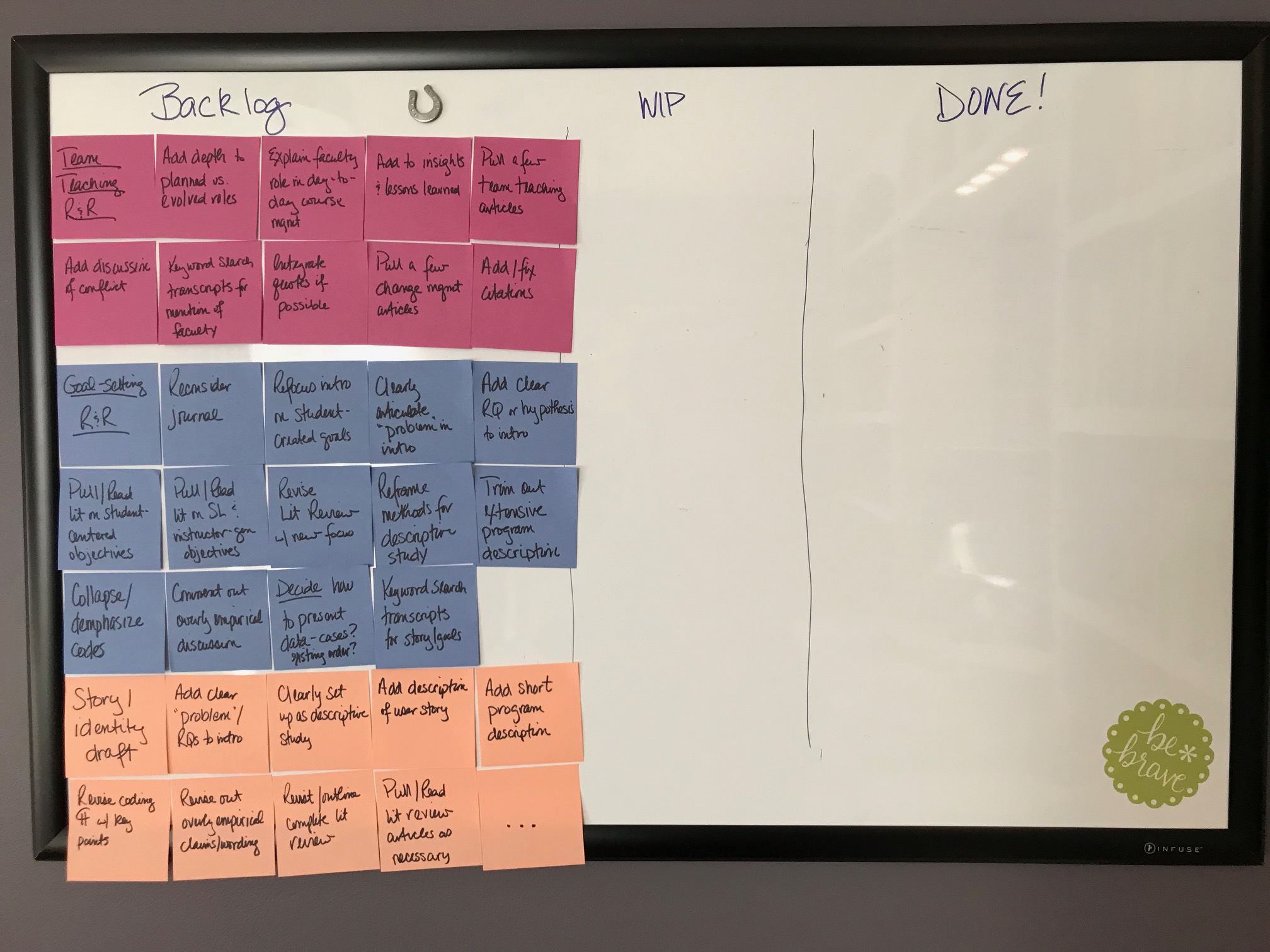
How will the Sprint Challenge work?
Every weekday afternoon around 3pm for the next three weeks and using the hashtag #AFSprint, I’ll post my answers to the daily Scrum questions to review what I accomplished that day and to set up my work for the next day. I’ll also post a picture of my updated Scrum board every morning. During the day, I’ll dedicate at least three full hours to writing. I’ll pop onto Twitter occasionally during the day to share insights, accomplishments, and blockers. I’ll also blog here at the end of each week to share my overall progress toward meeting my sprint goals. I hope you’ll follow along and find some tips and inspiration!
Do you have writing goals you want to tackle in January?
Interested in some social accountability and encouragement? Tweet me that you want to join the Sprint Challenge, share your writing goals, make your Scrum board (I’m available to coach you in that process!), and join me in tweeting about progress using the daily Scrum questions and hashtag #AFSprint!

 Happy New Year, Agile Faculty! I hope that you are well-rested, centered, and ready to jump into reaching your goals through productivity and with vitality. Last week was all about completing my end-of-year review and retrospectives so I had a sense of what I had produced and how effective my process was for accomplishing my goals. This is the point in a Scrum team’s sprint that they would take the feedback collected from the review and retrospective to move into planning the next sprint. So that’s my next step as well.
User Stories as Goal-Setting Tool
Throughout Agile Faculty, I talk about how you can adapt the user story format that software teams use to understand work they need to do next to articulate and set meaningful goals. The most basic format, according to the guy who wrote the books on good user stories, Mike Cohn, looks like this:
As a <type of user>, I want <some goal> so that <some reason>.
Using this formula reminds the team that they are developing software for real people with real needs and goals. Thinking this way help the team focus on what their users really need, want, and prioritize so they can stay focused and not wander down code wormholes.
In the book, I articulate a variation of the user story that you can use in your own planning as well as with students and peers in teaching, advising, and mentoring interactions. My version looks like this:
As a <type of person>, I want to <be able to do something> so that I can <accomplish some meaningful goal>.
RPR’s 2018 Planning Using Stories
As I mentioned in my last post, I tend to do big planning meetings with myself at the breaks of the academic year – before spring semester, summer, and fall semester. While I try to set an intention for the year, I don’t write stories or plan for the entire calendar year because I was to be flexible and responsive. For example, I know there will be ton of scholarship to come out of the second pilot of the Design Thinking Studio in Social Innovation this spring, but I can’t possibly know what we might want to write or pursue.
So this year, I set aside time to brainstorm a variety of possible epics – basically big stories that will take more than one sprint to complete – that could guide me this winter and spring. I’m kicking around some themes or intentions for 2018 that guided this brainstorm – play bigger (based on Tara Mohr’s coaching program), add value (as a reminder not just go through the motions), and “vitality > productivity” (which is the core theme of my Agile Faculty work). With this in mind, I first listed a variety of roles or identities at play in my life:
- instructor and mentor to undergraduate students
- faculty member with leadership roles in my department, our professional writing and rhetoric program (which is starting a stand-along major in 2018), our design thinking initiative, and social climate work
- researcher of student collaboration, rhetorical professional writing pedagogies, and faculty development with Scrum
- writer of academic articles, essays, and books
- Scrum professional and aspiring Agile coach in higher education
- person with interests and life goals outside of higher education.
From there, I generated user stories that aligned with these identities. Here’s a few samples:
- As a leader and faculty member in our PWR program, I want to create a solid foundation for the new major in terms of marketing, recruiting, and prioritizing PWR so that I/we can realize our dream of a strong and vital PWR presence on campus and in students’ education.
- As a leader in our Design Thinking Studio program and related design thinking initiatives, I want to collaborate with colleagues and students to create a viable curricular and co-curricular pathway to the Studio so that I/we can provide our students with powerful learning opportunities that focus not just on knowledge acquisition and skills but also on core liberal arts capacities like empathy, resilience, perseverance, collaboration, and curiosity.
- As a writer, I want to develop, visualize, and sustain a clear pipeline of my writing projects in their various stages so that I can better integrate writing into my daily habits, especially during the Spring semester when I tend to de-prioritize anything writing-related.
Once I had a bunch of possible epics, I took a break before returning and selecting three to guide me during the first five months of 2018. Next, I generated smaller stories from the epics – stories that could generally be completed in sprints of less than a month. For example, for my writing epic, I created stories about actually creating the pipeline, clearing three lingering articles off my plate quickly, creating an advice essay series based on Agile Faculty to shop around, and writing and finding a home for a possible Agile Faculty companion piece I’d like to write with a former student.
And finally I planned my first sprint, setting up a sprint backlog for the month of January (since I’m not teaching and have some concentrated time for writing and thinking). You can learn more about that, and even participate with me in a January writing sprint if you are looking for support, encouragement, and accountability. Look for blog and Twitter posts tomorrow with more info!

 Welcome back for part 2 of my year-end review and retrospective. While the new year might seem to be an arbitrary time to take stock and plan for the future, it is still a time that encourages us to check in with ourselves and (re)assess and (re)commit to goals we care about. I actually do this work three times a year, more in the rhythm of the academic year than calendar year. So while I might be setting big intentions for a calendar year, I know I’ll be checking back in on specific priorities and commitments in a few months at another natural reflection point in time.
In the first part of this post, I did more of a Scrum review, which looks at the products created in 2017. In this post, I’m sharing my retrospective, which is an assessment of the process I used, consciously or not, to keep true to my priorities and goals in 2017.
This year, I’ve become much more committed to understanding my process and the mindsets that led to my successes and challenges, most likely from spending the year thinking about, teaching, and researching the Scrum and design thinking processes. I’m also at the point in my career that I’m not as worried about my “productivity” in the traditional sense because I’m not worried about tenure or promotion; instead, I’m more interested in shaking up my career trajectory, trying new things, taking some risks, and generally playing bigger to see what I’m capable of – I’m more interested in vitality than productivity (which is definitely going to be my personal theme in 2018).
When a Scrum team holds a retrospective meeting at the end of a sprint, it’s an opportunity to inspect and adapt their process – how well are they supporting each other in how they achieve their goals, and what can they do better next time? This is one of the things I love about Agile and Scrum – the practices are designed not just to create conditions for continuous, regular, incremental progress on product goals, but also conditions that support the personal and professional development of every member of the team.
There are many ways to do a retrospective, ranging from the straight-forward to silly games (see this website and this website for many options to choose from). This time around, I decided to use the Open the Box format for my personal retro. You start by imagining that all the elements of your process reside in a cardboard box. Your task is to decide what you should remove from the box, recycle, and put in the box. I did this with art paper and sticky notes to have some fun and make the retro tangible (something I can save and display for the semester). I set a timer for five minutes, and here’s what I came up with:
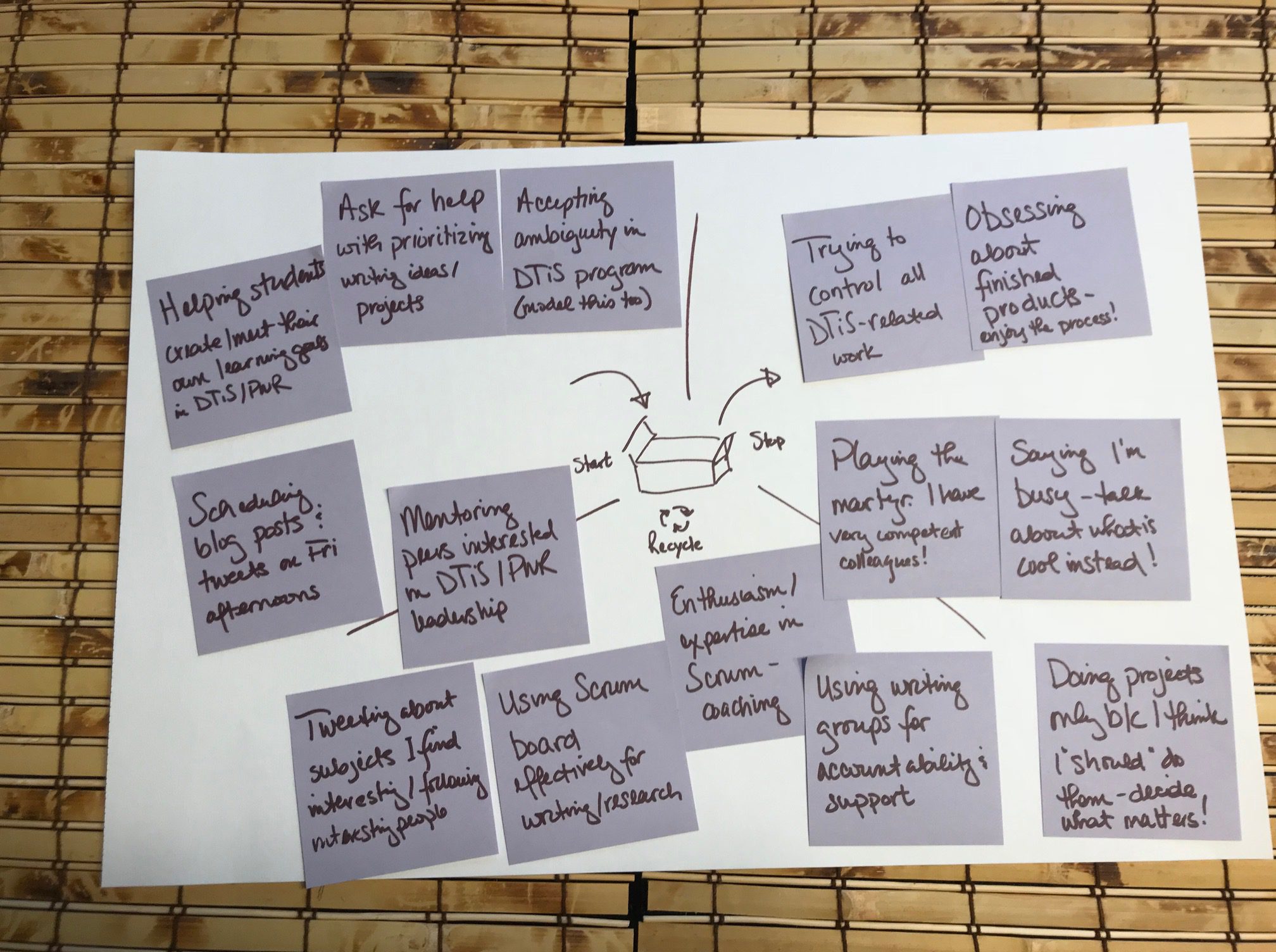
So this activity tells me a few things – that I want to tame my inner control freak to be a better colleagues and collaborator and that I want to find more joy in my work by more intentionally choosing what to work on and cultivating/sharing my enthusiasm for my work in different ways. Based on these findings, I plan to take the following steps during the first third of 2018:
- Whenever I feel my inner control freak taking over, ask myself what is causing the desire to control whatever is happening, what would happen if I didn’t take control, and how I might share control with trusted colleagues instead.
- Regularly express my gratitude to my colleagues by asking for and offering help/support.
- Share my interests in my projects/research/activities through different types of regular writing – research articles, essays, blog posts, and tweets, and connect to people with similar interests.
- Keep my Scrum board prioritized and updated weekly – if something stays on the board for more than 3 weeks and doesn’t move, revisit if the project is worth doing and, if so, determine how and when to get it unstuck.
Completing this retrospective has given me a realistic assessment of how I’ve been working this year and what I can actively do to improve not only my productivity, but also my relationships with colleagues, my enthusiasm for my work, and my own vitality.
Do you take stock of how you are approaching your work? What methods do you use? How might you separate out a review of the work accomplished from the way you accomplished that work? Why might that be valuable for you?
When I look back on 2017, other than political strife and anxiety, my year was really about three professional priorities – piloting the Design Thinking Studio in Social Innovation immersive semester that I co-designed as well as Agile Faculty and reconnecting to my larger goals related to that part of my career. In this post, I explain how I modified the daily Scrum questions for a year-end review. In a post later this week, I’ll share how I evaluated my process using a retrospective activity.
This year, I experimented with using the daily Scrum questions to understand how 2017 went because I wanted to explore if I met my 2017 commitments and could demonstrate that to others. It also made sense because this format helped me complete my required year-end review for my department chair and dean. During a daily Scrum in a software environment, the team meets in a designated location and each answer three questions:
- What have I done since we last met to work toward our team’s goals?
- What will I do today to work toward our team’s goals?
- Do I see any impediments that might keep me or the team from meeting out goals?
For this year, I modified the questions for a year-end personal assessment and focused only on the first and third question, since I’ll cover the second question in my 2018 planning session:
- What have I accomplished in 2017 that helped me achieve my priorities for the year?
- What might I do in 2018 to achieve my priorities?
- What might have hindered me from meeting my 2017 priorities that I need to be aware of in 2018?
Here’s what I found by using these questions to guide my assessment.
What have I accomplished in 2017 that helped me achieve my priorities for the year?
My goals related to launching the Design Thinking Studio in Social Innovation were mostly met, though it was much more stressful than anticipated. We successfully led the pilot semester with 14 students, and our team-teaching partnership was very successful, providing a much needed support system when things got bumpy. The students learned a great deal about design thinking, Scrum, and community action, while also learning hard-won lessons about goal setting, perseverance, challenge, ambiguity, collaboration, and constructive criticism. Those lessons were personally challenging for all of us, but the outcomes were well worth it. The faculty, with help from the students, also came up with a variety of ways to improve the program in its second pilot in Spring 2018, which we are now working into the curriculum.
Over the summer, the faculty team outlined five possible journal articles and submitted two, which earned revise and resubmits; crafted a report for the provost based on the results of the semester; and submitted a proposal to a major academic press for an edited collection on redesigning the liberal arts in undergraduate education which was inspired by our Studio work. I also wrote and earned a $10,000 from a disciplinary organization to study rhetoric genre transfer in the Studio and wrote a $35,000 planning grant to the new National Endowment for the Humanities’ Connecting Humanities program to explore creating a pipeline of classes and experiences to feed the Studio.
My Agile Faculty goals were very vague at the start of 2018 because I wasn’t sure when the book would be released (it was pushed back a couple of times based on the publisher’s production schedule). So Agile Faculty took a major backseat to the Design Thinking Studio until about October, when the November release date was firm. Thanks to conversations with the wonderful marketing team at University of Chicago Press and finding Katie Linder’s work on promoting academic books (she also has a full online course on the subject!), I updated all of my university and LinkedIn profiles to include the book, designed a website that I am really proud of, started blogging about Scrum in higher education, significantly ramped up my Twitter presence and targeting, joined relevant professional groups for networking and support, and started imagining plans for ways to extend Agile Faculty into related ventures.
My teaching is noticeably missing from these goals, which is something I really need to consider in 2018.
What might have hindered me from meeting my 2017 priorities that I need to be aware of in 2018?
I spent much of 2017 letting my inner control freak lead my efforts and attention, especially with anything that involved writing. While that enabled me to accomplish quite a bit, it was unnecessarily stressful, and I was sometimes overbearing with colleagues who were not on my self-imposed (and ridiculous) schedule. I could have trusted my very capable colleagues (and my students) more, used my Scrum board more effectively to maximize found time, and been more open to ambiguity and play.
2017 was also a year of many important commitments tugging on me regularly and distracting my ability to focus. Other areas of my work life probably suffered because of this, and I may have burdened colleagues with my attitude at times. For example, my colleagues and I finally got a new major approved for professional writing after 10 years of trying, and I should have made that more of a priority, even though we were very successful. I need to think about how much work is enough to meet my goals adequately and how much is superfluous stress I am putting on myself so that I can recognize small wins and celebrate big wins more readily.
 Additionally, my professional and personal goals were competing for my time, and work almost always won over personal. I’m not OK with that, especially when that mindset made my dressage riding hobby and lessons seem like a chore that was taking me away from work rather than the fun, healthy break from reality is should be. In 2018, I need to rethink the way I distribute my time and attention as well as commit to self care and riding while making my priorities visible to myself and others. (Curious about dressage? Here is an awesome animated video explaining the sport!)
So, while I was productive in 2017, I could have acted in ways that also improved my professional and personal vitality. In my next post, I’ll explain how I completed a 2017 retrospective to think about how my process for meeting my ambitious goals impacted both my productivity and my vitality and what I can improve in 2018.
Do you do a year-end review? What strategies work for you, and why?

As the year wraps up, I want to thank you for visiting and taking a look at Agile Faculty. I hope you’ll take the opportunity to hold a professional retrospective of the year past – what did you do to accomplish your goals in 2017? What will you do in 2018 to continue to work toward you goals? And what areas might you need some additional support or resources? This little check-in can help you recenter on your goals and make realistic plans for the new year.
I’m taking a little holiday break but will be back in January with more features about Scrum, book reviews, and practical resources. Happy holidays!

 A Scrum board is a simple way of visualizing the work you want to do, are currently doing, and have completed. The most basic Scrum boards have only three columns – Backlog (or To Do), Work in Progress (WIP), and Done. Visually, I always make the WIP column narrower than the other two as a reminder that I can only focus on a few tasks at a time if I want to do them completely and well. Agile Faculty can use Scrum boards to keep track of research and writing progress, to help student teams keep track of project work, and to keep a committee or task force on track when pursuing a specific charge.
Below is a sample of one of my personal Scrum boards and a student group Scrum folder. More samples of Scrum boards are shown throughout Agile Faculty.
While I prefer a physical board, a wall, a white board, even a manila folder all work, you can use collaboration software to 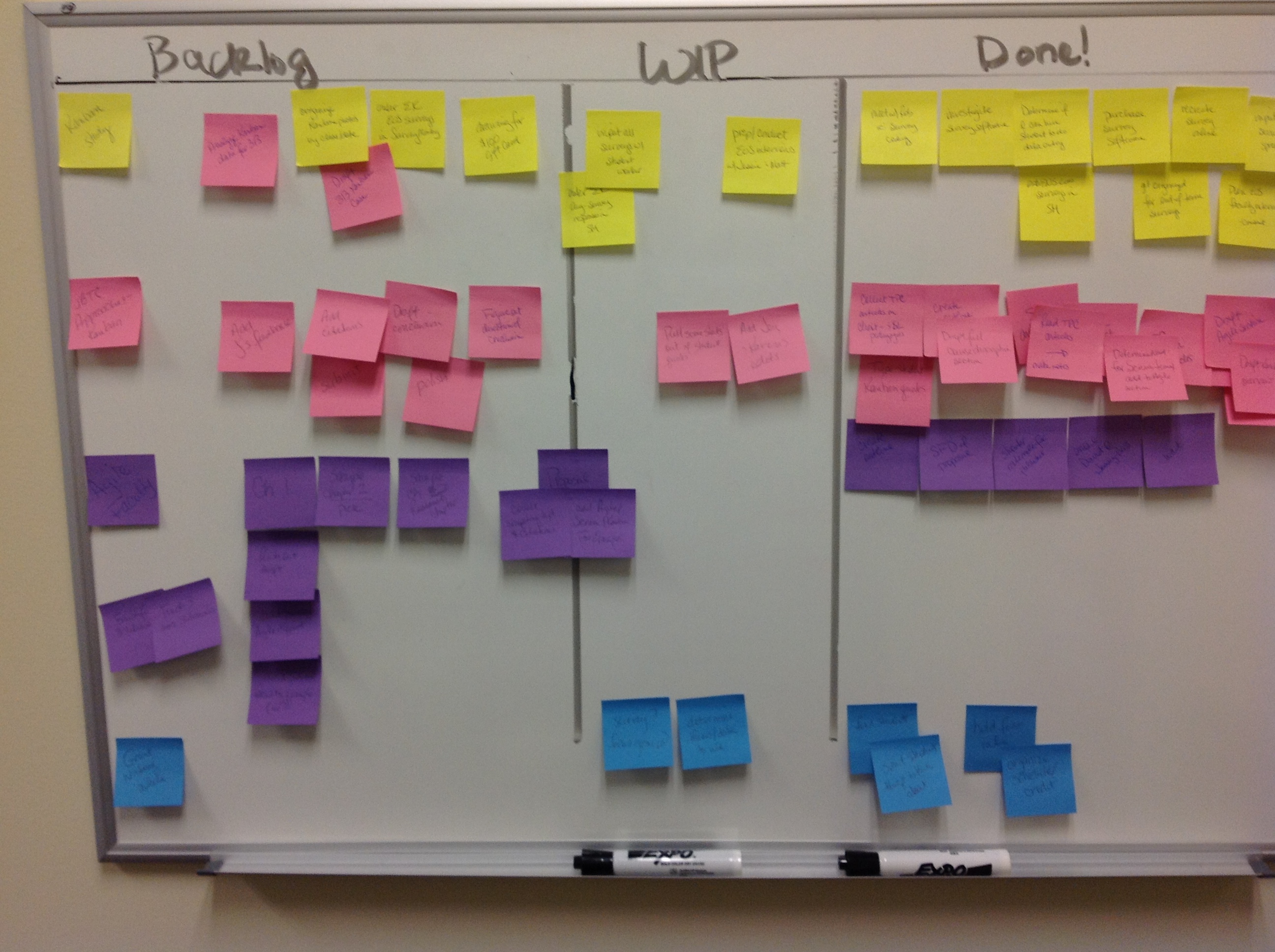 create Scrum boards and backlogs for distributed teams, which can be useful for work such as multi-institutional research projects. I don’t use or endorse any specific project management software, but here are two articles that have compiled information about some of the most usable packages available, some free and some subscription- or user number-based. This article lists what it has identified as the top seven software
  packages, while this article compares 13 software packages, specifically for combining Agile/Scrum and e-learning. For additional advice on how to create and implement a Scrum board, check out Agile Faculty as well as this great article with detailed steps.
And here’s a video of me talking about how to use the manilla folder Scrum board (or Kanban, which is Japanese for “signboard”) with students.
During the week of December 11tth, I tweeted out quick points from Chapter 2 of Agile Faculty – “Working the Agile Way with Scrum.” Here’s what we covered:



Every Thursday, I’ll be briefly reviewing a book that I find to be interesting, engaging, and valuable for Agile Faculty. Because the Agile Faculty mindset values exploration, curiosity, and multidisciplinarity, these resources will come from a variety of different areas that speak to a wide range of interests, including higher education, faculty development, Agile and Scrum, design thinking and creativity studies, and social innovation. And I’ll throw in a little bonus review of a piece of fiction or non-fiction I’m reading just for fun.
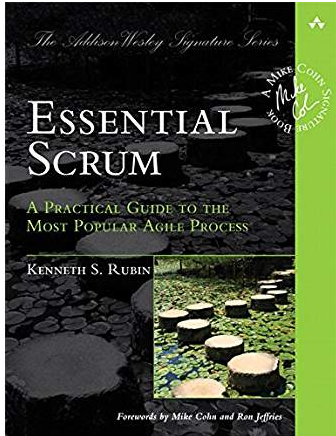 Today’s Book Club review is Essential Scrum: A Practical Guide to the Most Popular Agile Process, by Ken Rubin. Last week’s book, Scrum: The Art of Doing Twice the Work in Half the Time, but Jeff Sutherland, is a useful text that covers the philosophy behind Agile, role of empirical control theory in Scrum, and the Scrum process itself, which is very accessible to those not in the tech industry. If you are looking for a more technical, software development-driven look at Scrum, Rubin’s book is the place to start. It’s a textbook for Scrum, published by Addison-Wesley through leading Scrum consultant Mike Cohn’s Signature Book series.
Rubin covers all aspects of Scrum in detail, supported by strong visuals and examples from his consulting work. He spends time explaining the foundations of Scrum and Agile principles that apply to iterative software development, offers chapters on every Scrum meeting and Scrum role, and really drills down into software-specific topics such as product requirements, technical debt, and product planning at multiple levels. It’s everything you ever wanted to know about Scrum from a technical perspective if you’ve never been introduced to Scrum before.
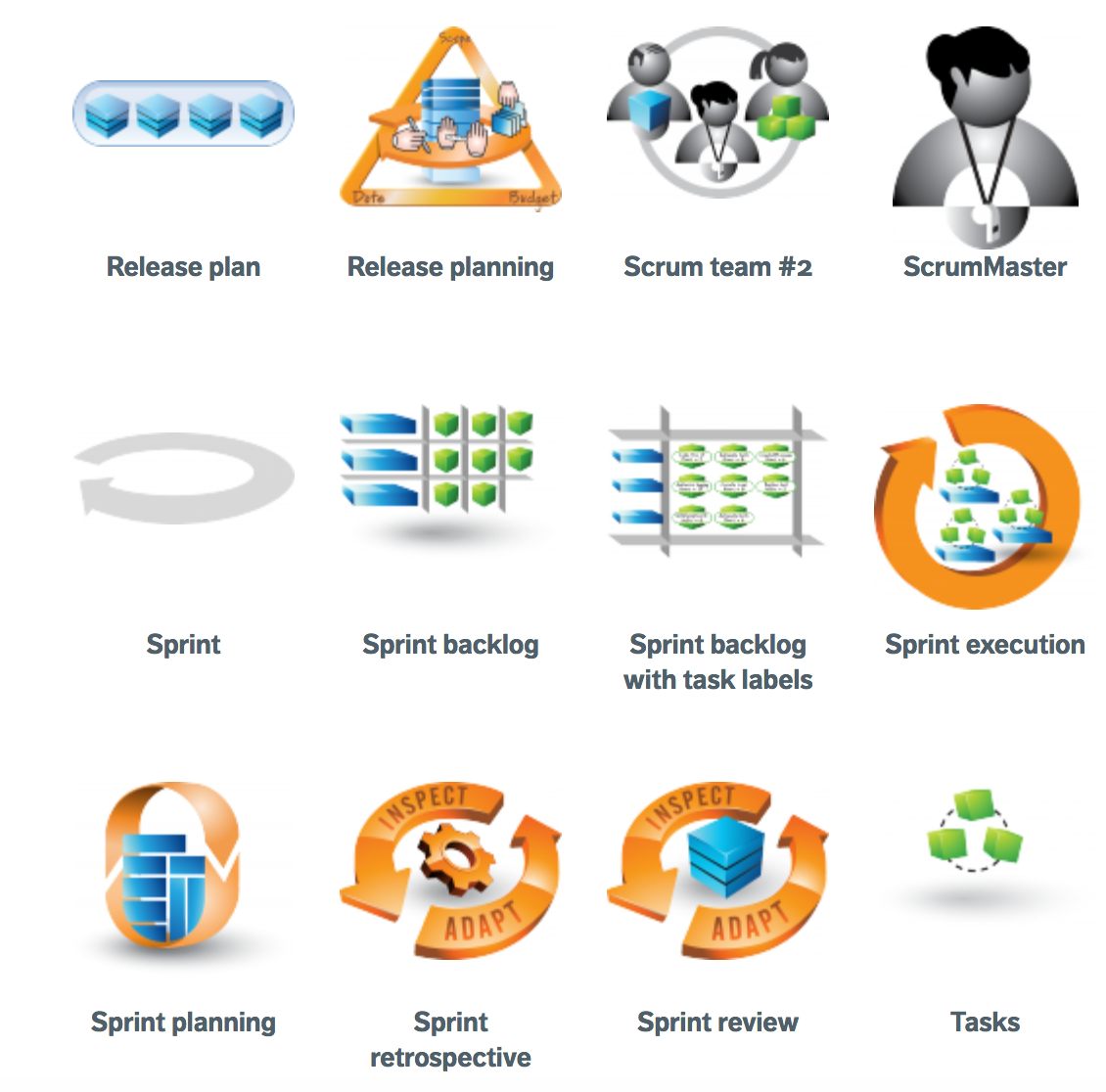 One of the things I really like about Rubin’s approach is the visuals. Though the text can get far down in the weeds sometimes and perhaps be not as interesting for non-technical people, he built a visual vocabulary for aspects of Scrum that really helps concepts make sense across the book. And, even better, Rubin makes his “AGILExicon” available for free on his consulting firm’s website. I’ve used his icons, with attribution, in a number of presentations I’ve given to faculty and students about Scrum, and the vivid icons really help capture the roles and the processes of Scrum very well.
So it you are looking for a one-stop text for the technical understanding of Scrum, I do recommend Rubin’s Essential Scrum – but treat it as a textbook to dip in and out of. There are shorter overviews out there if you aren’t interested in digging into the weeds. And there are other great texts that do deeper dives into aspects of the Scrum framework, especially related to the Scrum roles Scrum Master, Product Owner, and Agile Coach. I’ll review some of those more targeted texts in the future.
Completely Unrelated Bonus Review
 Since watching The Martian a few years ago, I’ve been very interested in near-future science fiction related to space travel. I did go through a period as a child when I was convinced I was going to go to the Air Force Academy and then become an astronaut – thought this dream was totally fueled by one too many viewings of the movie Space Camp. Anyway, if you are interested in similar hard science scifi, I unreservedly recommend Neal Stephenson’s Seveneves (2016). The book explores what happens to Earth and humanity after a space rock hits and breaks up the moon. It follows the stories of several people, including a roboticist on the Space Station and her father, a geneticist, an Elon Musk-like entrepreneur, a Neal deGrasse Tyson-styled scientist, and the president of the United States. It’s a thick book – Stephenson has a penchant for diving into the minutiae of the technology being developed and used by the characters – if that’s not your style, it’s pretty easy to skim through those parts, but I found them fascinating. You don’t find out what the title means, or even how to pronounce it, until the very end, but it’s totally worth the journey to get there.
 The answer is “yes, kind of.” Two primary organizations offer credentialing in Scrum: Scrum co-creator Jeff Sutherland’s Scrum Alliance and Scrum co-creator Ken Schwaber’s Scrum.org. These organizations set the standards and oversee testing for those teaching and pursuing certifications as Scrum Masters, product owners, Scrum professionals, and Scrum trainers. Scrum coach has become a increasingly popular certification route as well, combining executive coaching and Scrum training for those interested in enterprise-level Scrum leadership. This certification is overseen by the Agile Coaching Institute. Scrum Alliance also oversees certifications for Scrum Team Coaches and Scrum Enterprise Coaches.
However, there is no special Agile or Scrum certification training for academics – but, maybe, in the future… Most of the more advanced certifications and anything connected to Scrum coaching really demands hours in the field in technical organizations, so these are not yet realistic options for faculty in general. Regardless, if you are a faculty member interested in earning certifications and becoming an Agile leader on your campus, you have a few different options to explore.
Take an Agile or Scrum certification class for professional development. Trainers and coaches all over the US, Canada, Europe, and Asia offer a variety of courses to familiarize attendees with the mindset and practices of Agile and Scrum, ranging from Scrum basics to Agile coaching, with the most useful for faculty most likely being Scrum Master and product owner training. Regardless of if you are interested, or really even eligible, for certification, these two-day training sessions are great for learning more in-depth about how Scrum works in organizations. Look for a training session near you. I have personally taken the Scrum Master, product owner, and Agile coach training courses as research for Agile Faculty.
Become a certified Scrum Master. I have been practicing Scrum for nine years, and to complement my extensive reading and research, I have taken two Scrum Master training courses, one online and one face-to-face, and recently passed the test to become a certified Scrum Master Level I with Scrum.org. Scrum Masters are really facilitators, team supporters, and process leaders in Agile organizations, so this certification is most closely aligned with faculty work. With Scrum.org, you do not have to take a training course to gain access to the test, as you would with Scrum Alliance. The Scrum.org test is reasonably priced and based almost solely in content found in the Scrum Guide, but to gain access to the Scrum Alliance test, you must take one of their training courses which are somewhat expensive.
What’s the Scrum Guide? Sutherland and Schwaber have collaborated on the official Scrum Guide since 2010. In the most recent 2017 revisions of the Guide, Sutherland and Schwaber added a section that explains that while Scrum originated in software development organizations, the Scrum framework can be and has been used in many other types of organizations for many different purposes and that although the Guide continues to use the words “develop” and “development,” these terms refer to any type of complex work, not just software. I hope we will continue to see more attention to non-technology organizations in the future. You can find a discussion of the four revisions of the Scrum Guide between 2010 and 2017 here.
Reach out to local Agile and Scrum experts in your area. Unless your campus is relatively rural, you will likely be able to find experts within an hour of your location. I have found that many of them, especially coaches and trainers, are enthusiastic about spreading Agile and Scrum into other fields and are happy to talk over coffee or lunch about how Scrum might apply in higher education. Also, most cities or regions will have local Agile and Scrum meet-up groups which offer the opportunity to network with professionals and attend talks given by local practitioners. Look for meetups an even local Agile conferences in your area online.
Want a quick snapshot of what Agile Faculty is all about? Watch this short book trailer!
 rebecca pope-ruark